
October 8, 2026
Can You Add Lights to an Existing Landscape Lighting System? Expanding Before the Ground Freezes in Cincinnati
Most Cincinnati landscape lighting systems can take more fixtures. How we check transformer headroom and cable, and why to add them before the ground freezes.
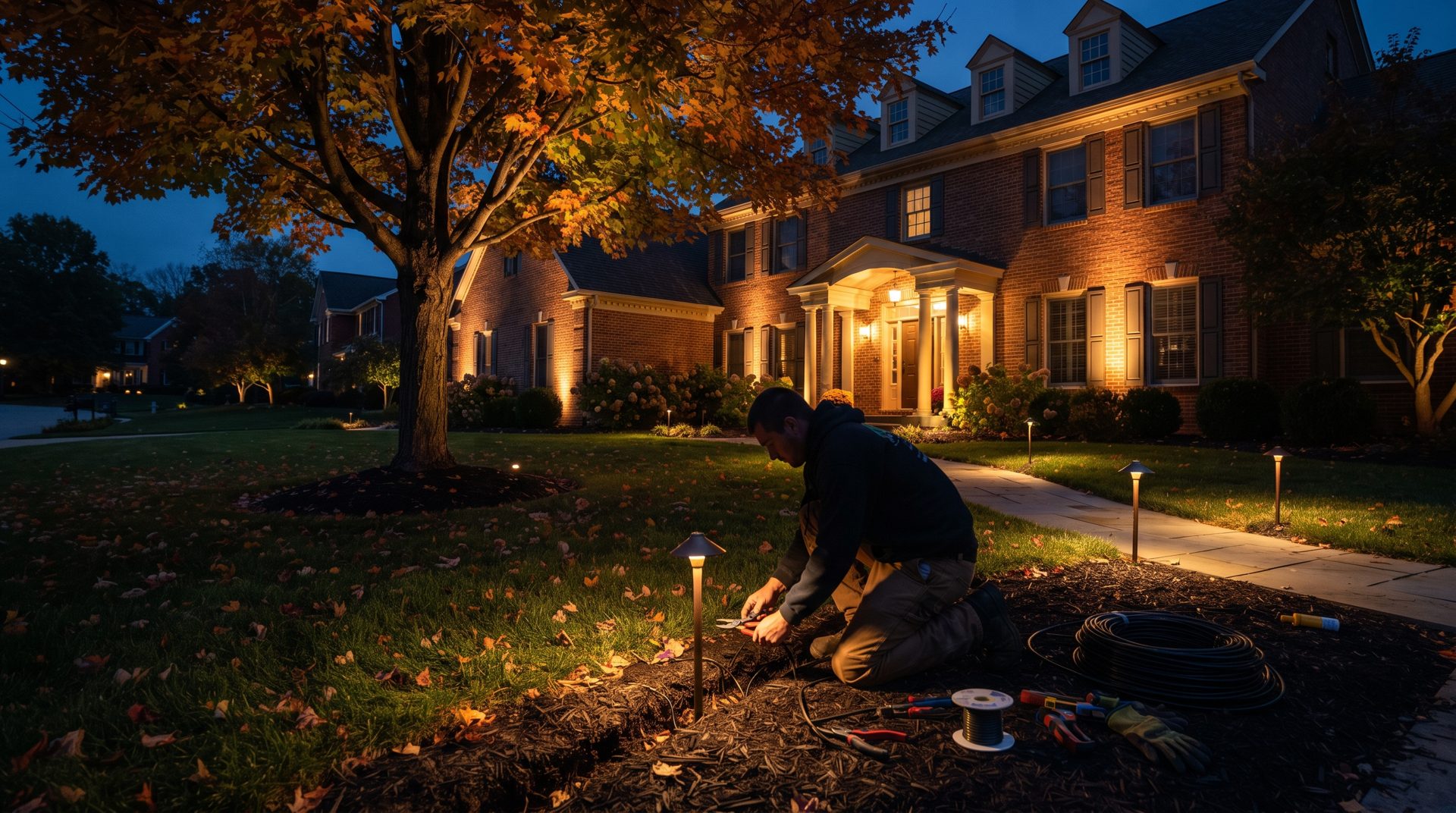
Every October we get the same call from homeowners across Greater Cincinnati: the path lights went in two or three years ago, the evenings are getting dark before dinner, and now they want the front of the house lit, or the big maple, or the back patio. The question is always whether the existing system can handle more fixtures or has to be torn out and started over. In most cases it can take more.
Can you add fixtures to an existing landscape lighting system?
Yes. In most cases a low-voltage landscape lighting system can take more fixtures without replacing the transformer or the cable already in the ground. Whether yours can depends on how much wattage the transformer has left, how much load the existing cable runs can carry, and whether the new fixtures match the old ones electrically.
A low-voltage system is modular. Adding a fixture means tapping into an existing cable run or adding a new run off a spare terminal on the transformer, and neither requires digging up what already works.
The exception is a system that was undersized on day one. A transformer already at its limit, or a single thin cable feeding twenty fixtures, has no room to grow. We see this on a lot of bargain installs around Mason and West Chester, and it is the one case where an expansion turns into a rebuild.
How do you know if the transformer has room for more lights?
Add up the wattage of every fixture on the system and compare it to the transformer's rating. If the total is at 80 percent of the rating or less, there is room. If it is near the ceiling, the transformer gets upgraded before anything is added.
The rating is printed on the transformer case, usually 150, 300, 600, or 900 watts (the label may say VA, which for this purpose is the same number). Modern LED path lights and uplights draw 3 to 7 watts each, and LED floodlights 8 to 15 watts. A 300-watt transformer feeding twelve 5-watt path lights is carrying 60 watts, which leaves room for a dozen uplights on the house and a few more in the trees.
An older halogen system is a different picture. Halogen path lights draw 20 watts each and uplights 35 to 50, so the same 300-watt transformer with twelve halogen path lights is already at 240 watts. In that case we swap the halogen lamps for LED on the same visit, which frees up most of the transformer, and the new fixtures go on the capacity we just recovered. We size for 60 to 80 percent load, never the full rating, because a transformer at its limit runs hot, the voltage sags, and the fixtures at the far end of the run go dim first.
Why does cable capacity matter as much as the transformer?
Every fixture added to a run pulls more current through the same wire, and voltage drops along the wire in proportion to the current and the length of the run. A far fixture that is already dimmer than the first one gets dimmer still when you add to it.
Most systems in Greater Cincinnati are wired with 12-gauge cable, which carries a typical LED run of ten to fifteen fixtures over 100 feet or so without trouble. The cheap kits use 16-gauge, which is fine for four lights and a problem for ten. We check with a meter at the fixture farthest from the transformer, where each fixture should see between 10.5 and 12 volts. If the far fixture reads 9.5 volts before anything is added, we do not add to that run. We move it to a higher voltage tap, split the run, or run a new home run straight from the transformer. A new cable is often the cleanest answer, and in October it is also the easiest, because the ground is soft and the beds are being cut back anyway.
What can you add to a system that already has path lights?
Path lights are usually the first thing installed and the least interesting part of a finished design, so the common additions are uplighting on the house, lighting in the trees, and light on the parts of the yard you use after dark.
- Brass uplights at the base of columns, corners, and brick piers. Four to eight fixtures covers the front of most homes in Montgomery, Indian Hill, and Hyde Park.
- Uplights in the root zone of a mature oak or maple, or moonlights mounted 20 to 30 feet up in the canopy. Two or three fixtures per tree.
- Shielded floodlights on the driveway and garage, aimed down so the light lands on the pavement and not in the neighbor's windows.
- Downlights from a pergola or low path lights around a patio, so the back of the house gets used past 7 PM in October.
All of it ties into the existing transformer and timer as long as the headroom is there.
Do new fixtures have to match the old ones?
They have to match electrically and should match visually, but they do not have to be the same brand. Any 12-volt LED fixture runs on any 12-volt landscape transformer. What has to line up is the color temperature of the light and the look of the fixture body.
Color temperature is the one most homeowners miss. If the existing path lights are 2700K, a warm amber white, and the new uplights come in at 3000K or 4000K, the house looks cooler and bluer than the walk and the mismatch is obvious from the curb. We match the new lamps to the existing ones, or bring everything to 2700K in one pass. Brass darkens to a bronze patina over a few Cincinnati winters, so a new brass uplight next to a three-year-old one looks different for a season and then blends. If the existing fixtures are failing, we say so and quote replacing them rather than adding good fixtures to a bad system.
When we tap into an existing run, we cut out the old pierce-point connector, the most common cause of a dead fixture we find on repair calls, and make the new splice with a waterproof gel-filled connector. The expansion fixes the weakest point on that run at the same time.
How much does it cost to add fixtures to an existing system in Cincinnati?
Adding to an existing system costs less per fixture than the original install, because the transformer, the timer, and the main cable runs are already paid for. In Greater Cincinnati, expect the per-fixture price to sit at the lower end of the $200 to $650 installed we quote for new systems, depending on fixture material, how far the new cable has to run, and whether anything on the existing system needs to be corrected first.
Three things push the price up. A transformer upgrade, needed when the existing unit has no headroom and the system is already LED. A new home run to a part of the property the original install never reached, like the back patio or a tree line at the edge of the lot. And repairs: corroded connectors, a nicked cable, halogen lamps that need to come out. We find those on the pre-expansion check and quote them separately so you can see what is expansion and what is repair.
Most companies in the area will only add to a system they installed. We expand any brand of low-voltage system, including the one the previous owner put in, and if we did not install it the first step is a walk-through with a meter so we know what we are adding to.
Why add fixtures before the ground freezes?
Low-voltage cable goes in the ground, and once the top few inches of soil freeze in Greater Cincinnati, trenching for new runs stops until spring. That usually happens in December, though a cold snap can bring it earlier. The window to add a run is now through the end of November.
October is also when the gaps are easiest to see. Sunset in Cincinnati is already before 7 PM, and when daylight saving time ends on Sunday, November 1, it drops to about 5:30 PM. You will be looking at the dark side of your house every evening for the next four months. The beds are cut back and the mulch is thin, so a cable goes in without disturbing anything that is growing, and the new uplighting is finished before the holidays and still up in January when the decorations come down.
Fixtures can still be added in winter if they tap into a run that is already in the ground. What cannot happen in January is a new 80-foot trench across frozen turf.
What should you do before calling about an expansion?
Walk the property after dark and write down what you want lit and what you can see of the existing system. That short list is most of what we need for an accurate quote.
- Find the transformer and note the wattage on the case.
- Count the fixtures and note whether the lamps are LED or halogen. If a lamp is warm to the touch after an hour, it is halogen.
- If the last light on a run is noticeably dimmer than the first, tell us. That changes how we add to that run.
- Note any fixtures that are out. We fix those on the same visit. There is no reason to add eight uplights and leave two dead path lights.
We design, install, expand, and repair low-voltage landscape lighting across Maineville, Mason, West Chester, Loveland, Montgomery, Indian Hill, Hyde Park, and Anderson Township, and we work on systems we did not install. To get fixtures added before the ground freezes, call (513) 828-8501 or request a free estimate. We will meet you at the property at dusk, meter the existing system, and tell you plainly what it can take.
Want a property like the ones in this post?
Free on-site consultation across Greater Cincinnati.
Schedule a Free Estimate