
September 15, 2026
How to Light Fall Foliage in Cincinnati: Uplighting Maples and Oaks for Peak October Color
Greater Cincinnati's maples and oaks peak in the second half of October. How to uplight fall color, which trees are worth it, and what to do before leaf drop.
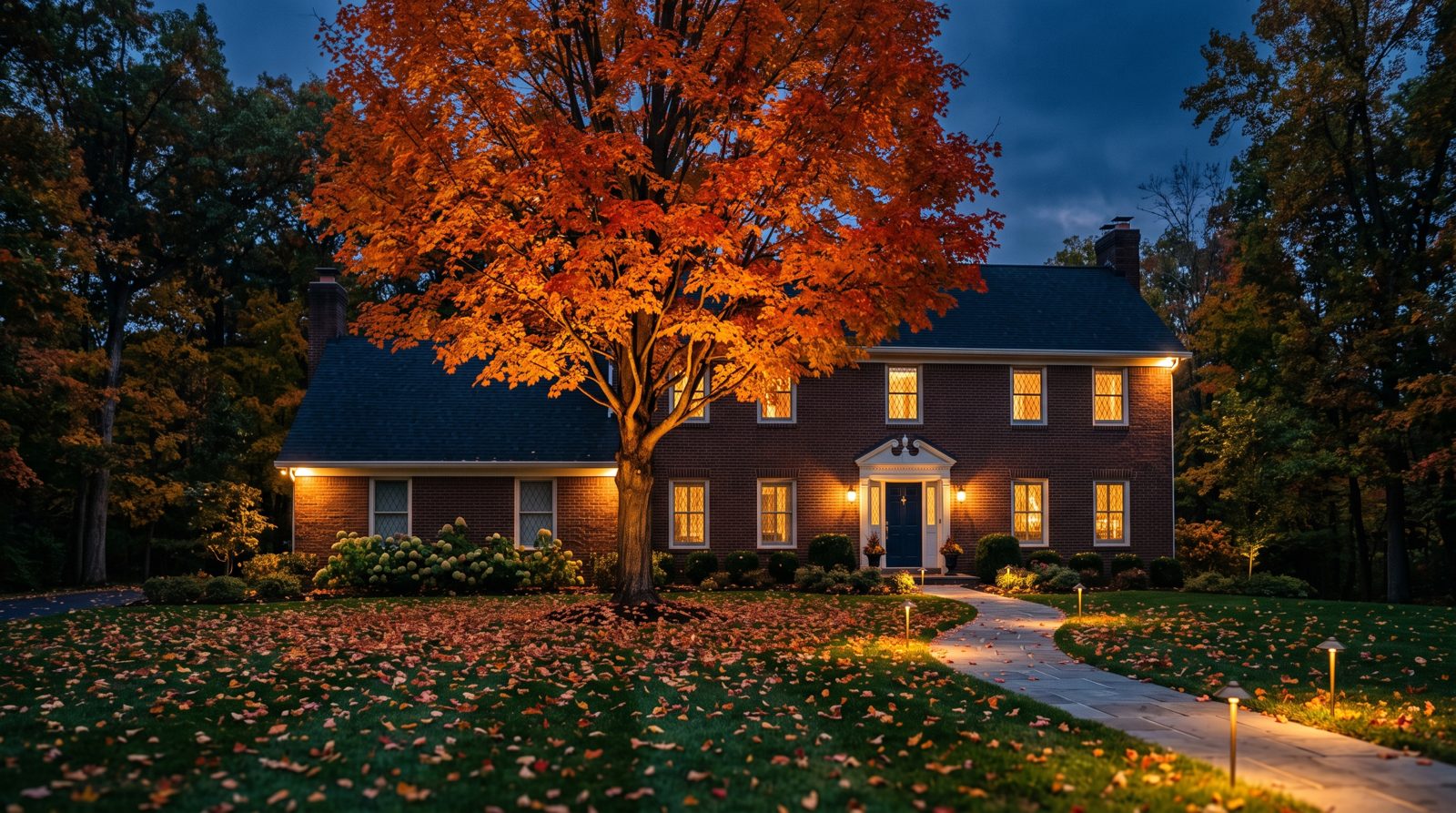
For about three weeks every October, the trees in Greater Cincinnati do something no fixture, plant, or hardscape can match. A sugar maple in Indian Hill or Montgomery turns solid orange, the oaks along the Little Miami go russet, and the whole yard changes color. Then it gets dark before 7 PM and nobody sees it. Tree lighting fixes that. A few well-aimed uplights turn a peak-color maple into the brightest thing on the street after sunset, and the same fixtures keep working after the leaves are gone. Below is how we light fall color across Maineville, Mason, Loveland, and the rest of the Cincinnati area, which trees give you the most for the money, and what to handle before the leaves drop.
When does fall color peak in Greater Cincinnati?
Fall color in the Cincinnati area usually peaks in the second half of October, with the best two weeks landing somewhere between the 15th and the end of the month depending on the year. Maples turn first, oaks last, so a yard with both species holds color for close to a month. The other thing that changes in October is the clock. Sunset in Cincinnati is already before 7 PM by mid October, and when daylight saving time ends on Sunday, November 1, 2026, it jumps to roughly 5:30 PM. That means peak foliage overlaps almost exactly with the weeks when people come home from work in the dark.
Why do uplit trees look better in fall than any other season?
Uplit trees look better in October because the leaves are lighter, more translucent, and more saturated than they are in summer, so they hold and throw light instead of absorbing it. A dark green summer canopy soaks up most of a 500-lumen uplight. The same fixture on an orange maple lights the whole canopy from the inside and reads from two houses away. Warm-white LED at 2700K sits close to the color of the leaves themselves, which is why fall foliage under landscape lighting looks amplified rather than washed out.
Contrast helps too. The sky goes deep blue earlier, the lawn is darker, and fallen leaves make a warm ground plane around the trunk, so everything around the tree gets darker while the tree gets brighter.
Which Cincinnati trees are worth lighting for fall color?
The trees worth lighting for fall color are the ones with a broad canopy, a strong trunk line, and a leaf color that sits in the warm range. Across the yards we work in, these are the standouts:
- Sugar maple: orange to red, the single best tree to uplight in Cincinnati. One mature specimen can carry a whole front yard.
- Red maple: bright red, turns early, and holds a compact canopy that lights evenly with two or three fixtures.
- White oak and red oak: russet and bronze, turn late, and keep some leaves into November. Oaks extend the show after the maples are done.
- Shagbark hickory: clear gold canopy plus peeling bark that rewards a tight grazing beam on the trunk.
- Japanese maple: small, but a deep red one by the front walk takes a single narrow uplight and looks like a lantern.
Trees we skip for fall color: silver maples and honeylocusts drop their leaves fast and turn a dull yellow, and most evergreens are better lit as a backdrop than as the subject. Sycamores are worth lighting all year for the bark, not the October leaves.
How do you uplight a tree for fall foliage?
You uplight a tree for fall color with two to four ground-mounted LED spotlights placed 3 to 6 feet from the trunk, aimed up through the lowest branches so the light lands in the canopy rather than on the bark alone. The specifics that matter:
- A 35 to 60 degree wide beam fills a broad maple canopy. A 15 to 25 degree narrow beam grazes the trunk and pushes light higher into a tall oak. Most mature trees get one of each.
- We size trunk uplights in the 4 to 7 watt LED range, roughly 300 to 550 lumens, for most trees, and step up on the biggest oaks. In fall the leaves reflect more, so a fixture that felt underpowered in July often looks right in October.
- Stay at 2700K. Warm white deepens the reds and oranges. 4000K and above turns fall color grey.
- Crossfire the tree: two fixtures on opposite sides of the trunk kill the flat, one-sided look and light the back of the canopy that faces the house.
Moonlighting, where fixtures mount 20 to 30 feet up in the canopy and shine down through the branches, is the other technique that pays off in fall. Downlight through orange leaves throws warm, moving shadow patterns across the lawn and the fallen leaves below. It is a bigger job because someone has to climb, but on a large oak it is the most natural-looking effect we install.
Can you add tree lighting to an existing landscape lighting system?
Yes, and October is one of the most common times we do it. Most systems we see in Mason, West Chester, and Loveland were designed around the house and the walkway, with the trees left dark. Adding two to six tree uplights to an existing low-voltage system usually means running a new wire home run from the transformer and confirming there is enough capacity. A 300-watt transformer that is carrying 180 watts of path and facade lights has room for four or five 7-watt LED uplights with margin to spare. A transformer that is already near its limit needs a second unit, which we would tell you before quoting.
We also add trees to systems we did not install. Most companies in the Cincinnati market only want to sell a complete new system. We will open the transformer, find out what you have, and extend it, whether the original installer was us, a franchise, or a landscaper who is no longer in business. That includes older halogen systems, where the first step is usually swapping the existing lamps to LED to free up the wattage the new tree fixtures need.
What should you do with tree lighting before the leaves drop?
Before leaf drop, the three things to handle are re-aiming for the bare canopy, keeping fixture lenses clear of leaves, and adjusting your timer for the earlier sunset. In detail:
- Plan the re-aim. A fixture aimed to fill a full canopy will over-shoot once the leaves are gone and light the neighbor’s second floor. We re-aim tree uplights slightly lower and tighter for winter so they hold the branch structure instead of the empty sky.
- Keep lenses clear. A ground uplight buried under six inches of wet maple leaves throws no light and traps moisture against the fixture seal. Brass and copper fixtures handle it, but any fixture does better when the lens is cleared during fall cleanup. Tell your landscaper where the fixtures are before the leaf blowers come through, because a blower or mower deck is the number one way a tree uplight gets knocked out of aim.
- Reset the timer. If the system runs on a mechanical timer instead of a photocell or astronomic timer, it needs to move earlier as sunset falls, and again on November 1. A photocell handles this on its own. If you are not sure which you have, the fall check we run covers it.
How much does fall tree lighting cost in Cincinnati?
Adding tree lighting to a Cincinnati home in fall typically costs the same per fixture as the rest of a quality low-voltage system, which in 2026 runs $375 to $650 per installed brass or copper fixture, plus any transformer upgrade if the existing unit is at capacity. A single specimen maple with two crossfire uplights is at the low end of that. A large oak with four ground uplights and two moonlights up in the canopy is a bigger job because of the climbing and the longer wire runs. We quote after walking the yard at dusk, because tree size, trunk spread, and where the existing wire runs decide the number more than anything else.
When should you book tree lighting to catch this year’s color?
Book now if you want the fixtures in before peak color in mid to late October. Fall is our busiest install window, and a small tree-lighting add-on usually takes one visit once it is scheduled. Even a job that lands in early November is worth doing: the oaks are still holding leaves, the bare-branch structure of a lit maple is its own look, and the system is ready for next October and every one after it.
We design and install tree lighting across Maineville, Mason, West Chester, Loveland, Montgomery, Indian Hill, Hyde Park, and Anderson Township, and we maintain every system we build, including the ones we did not install originally. Call (513) 828-8501 or request a free estimate, and we will come out at dusk and show you what your trees can do this fall.
Want a property like the ones in this post?
Free on-site consultation across Greater Cincinnati.
Schedule a Free Estimate