
September 9, 2026
Fall Landscape Lighting Maintenance in Cincinnati: The 7-Point Check Before Winter
Leaves, mulch, summer growth, and the first freeze all hit a landscape lighting system in October. The 7-point fall check we run across Greater Cincinnati.
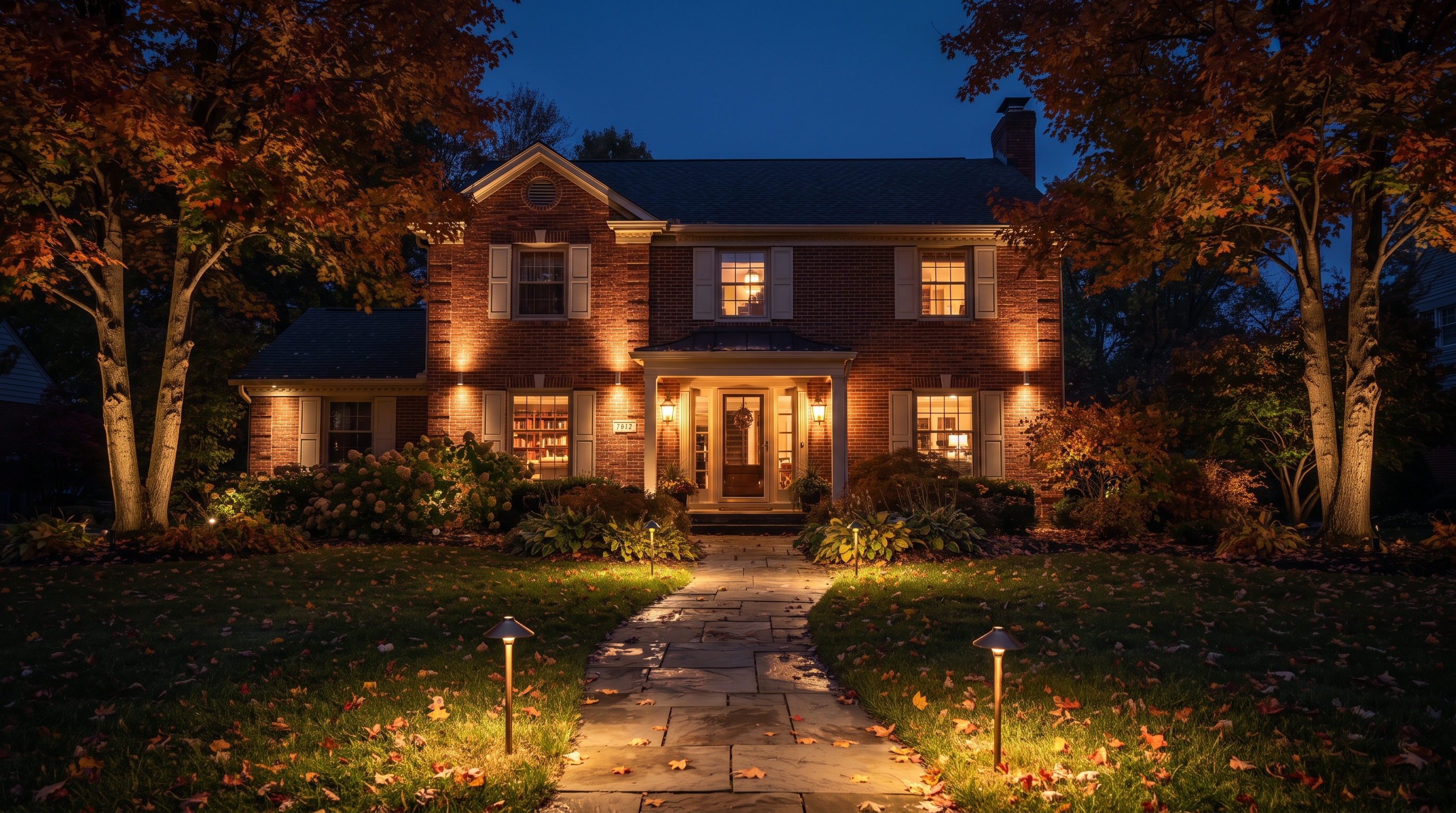
Every September we start getting the same call from homeowners in Mason, Loveland, Montgomery, and Maineville: the lights were fine in June, and now three of them are out, two are pointing into the lawn, and the whole run near the back fence flickers. Nothing broke overnight. A summer of growth, mowing, mulching, and thunderstorms did it slowly, and the shorter evenings just made it visible.
Fall is the best month of the year to catch this. Cincinnati sunset drops from about 8:00 PM at Labor Day to roughly 7:00 PM by mid October, so you are looking at your lighting for two to three hours every night instead of twenty minutes. The ground is still workable, the first hard freeze usually holds off until the second half of October, and the trees have not dumped their leaves yet. Here is the seven-point check we run on every fall maintenance visit, in the order we do it.
Why does landscape lighting fail more in the fall?
Landscape lighting fails in the fall because the damage from summer finally shows up at the same time the system starts running longer hours. Three things pile up between May and September.
- Plant growth. A boxwood that was 18 inches tall in April is 26 inches in September and now swallows the path light beside it.
- Landscaping work. Spring mulch buries fixtures and wire connections an inch or two deeper. Edgers nick direct-burial cable along bed lines.
- Water and heat. Twist-on wire connectors that were marginal in spring wick moisture all summer and corrode. Undersized transformers running at 95 percent load bake in a July garage and lose capacity.
Then the run time doubles. A system on a photocell that ran four hours a night in June runs eight to ten hours in November.
What is on a fall landscape lighting maintenance checklist?
A complete fall check covers seven items: fixture cleaning, re-aiming, plant trimming, mulch and grade correction, wire and connection inspection, transformer and voltage testing, and timer or photocell adjustment. Each one takes a few minutes per fixture on a well-built system, and each one prevents a specific winter failure.
- Clean the lenses and housings. Pollen, mower dust, irrigation spray, and spider webs build a film on the lens that can cut light output by a third. We wipe every lens with a soft cloth and a little water, and on brass fixtures we leave the patina alone.
- Re-aim every fixture. Uplights get kicked by kids, dogs, and mowers. Path lights get leaned on by mulch. We stand at the street after dark and walk the property, adjusting each fixture so the beam lands where it was designed to land: the trunk, the column, the walkway edge, not the neighbor's window.
- Trim what has grown over the fixture. A path light buried in a hosta is a fixture that lights the underside of a leaf. We cut back growth to give each fixture 8 to 12 inches of clearance.
- Pull fixtures back up to grade. Two seasons of mulch will bury a path light stake to the point where the fixture head is sitting on the mulch and the wire connection is four inches under it. We lift the stake, reset it, and make sure connections are at or just below the surface where they can dry out.
- Inspect every wire connection. This is the item that matters most. We open each splice and look for green corrosion, brittle insulation, and moisture inside the connector. Any twist-on connector or gel cap that shows corrosion gets replaced with a marine-grade, silicone-filled splice. On systems we did not install, this step usually accounts for most of the visit.
- Test the transformer and read voltage at the fixtures. We check the transformer under full load with a meter, confirm it is not running above 80 percent of its rated capacity, and read voltage at the first and last fixture on each run. Most LED landscape fixtures are rated for a range, often 9 to 15 volts, but a big spread between the first and last fixture on a run means voltage drop that will show up as dim or flickering lights at the far end once the nights get long.
- Reset the timer or check the photocell. A photocell should already be tracking the earlier sunset, but a mechanical or digital timer set in May is now turning your lights on an hour after dark. We reset it, and we clean the photocell eye, because a dirty photocell turns the lights on early and burns hours you are paying for.
How do fallen leaves affect landscape lighting?
Fallen leaves block light, trap moisture against fixtures, and hide wire damage until spring. In Greater Cincinnati the heavy drop runs from mid October into early November, and a wet leaf mat over a path light does three things at once. It covers the lens so the fixture throws no light. It holds water against the fixture housing and the wire entry point for weeks. And when the mat is finally raked or blown off, the blower crew often pulls a shallow wire connection out of the ground with it.
What we recommend is simple. Have your fall maintenance done before the heavy drop, in late September or early October, so every fixture is re-aimed, every connection is sound, and every fixture is sitting high enough to be seen when the blower comes through.
Should you turn landscape lighting off for the winter?
No. Low-voltage LED landscape lighting is designed to run year-round in Ohio, and the winter months are when it earns its keep. December sunset in Cincinnati is around 5:15 PM. The system lights your walkway and driveway for the six or seven hours a day when people are actually coming and going in the dark, and it costs very little to do it. A typical 20-fixture LED system pulls 80 to 120 watts total, which at Duke Energy residential rates is a few dollars a month even at ten hours a night.
What you should do before winter is make sure the system is ready for it. Freeze and thaw cycles move the ground and pull on shallow wire. And if a connection is already wet and corroding in October, it will fail in January, when nobody wants to dig.
The one thing worth turning off is a halogen system you have not converted yet. Halogen bulbs run hot, fail often, and cost real money to run ten hours a night through the winter. If your system still has halogen lamps in it, converting to LED before the long nights start is the single best return you will get on the whole system.
Can I do fall landscape lighting maintenance myself?
Yes, for the first four items on the list, and homeowners in Indian Hill and Hyde Park do it every year. Cleaning lenses, re-aiming fixtures, trimming plants, and pulling stakes back up to grade require no tools beyond gloves, a rag, and pruners. Low-voltage systems are safe to handle while running.
The last three items are where a service call pays for itself. Opening splices, replacing connectors correctly with the right waterproof splice, reading load at the transformer, and diagnosing voltage drop across a run all take a meter, the right parts, and the experience to know what the numbers mean.
If your system was installed by another company that no longer services it, or by a company that went out of business, that is not a problem for us. We service Volt, Kichler, FX Luminaire, Vista, Unique, Brilliance, Hinkley, Cast, Hunza, Coastal Source, Halco, and any other low-voltage system. We keep parts for older systems and we fix what others will not.
What does a fall landscape lighting service visit include in Greater Cincinnati?
Our annual maintenance visit covers bulb or LED engine replacement, fixture re-aim, connection inspection, a transformer test, and seasonal cleanup, and for a typical residential system it is done in one visit. We work across Maineville, Mason, West Chester, Loveland, Montgomery, Indian Hill, Hyde Park, and Anderson Township, and we schedule fall visits from mid September through the end of October so the work is done before the leaves and the first freeze.
The best time to book is now. Call (513) 828-8501 or request a visit online, and we will get your system back to 100 percent before the long nights arrive.
Want a property like the ones in this post?
Free on-site consultation across Greater Cincinnati.
Schedule a Free Estimate