
September 24, 2026
Halloween Walkway Lighting in Cincinnati: How to Light Your Path for Trick-or-Treaters
Halloween 2026 sunset in Cincinnati is about 6:35 PM. How to light a front walk for trick-or-treaters without extension cords, and keep it for winter.
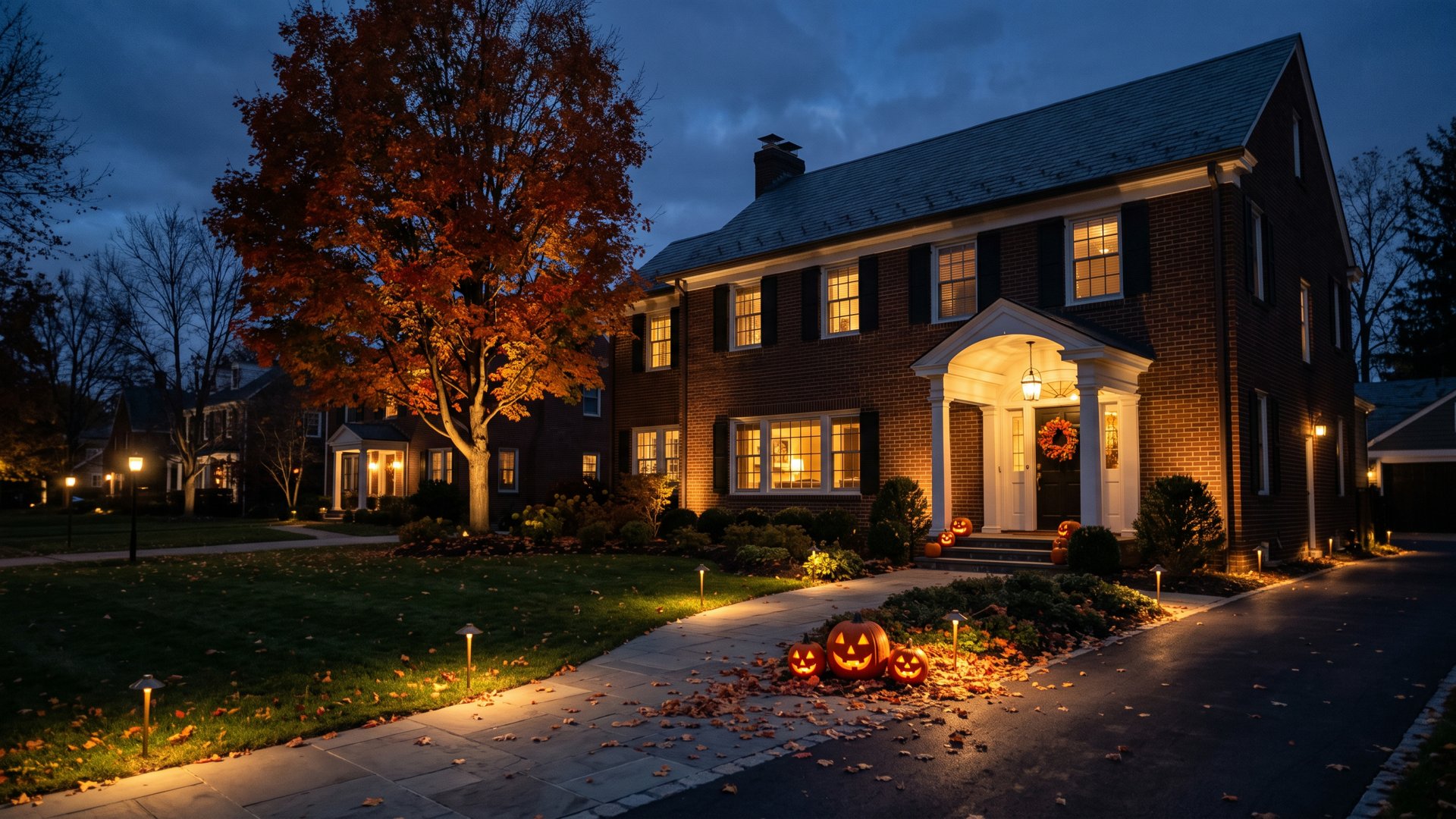
Halloween 2026 lands on a Saturday, October 31, and in Greater Cincinnati the sun sets around 6:35 PM that night. Most communities in Warren, Hamilton, and Butler County post trick-or-treat hours somewhere in the 6 to 8 PM window (check your city or township site for the exact times), which means the second half of trick-or-treat happens in full dark. Then, the very next morning, Sunday, November 1, daylight saving time ends and sunset jumps back to about 5:30 PM for the rest of the year. Here is how we light a front walk for that week across Maineville, Mason, Loveland, West Chester, and the rest of the Ohio side of the river.
Why does walkway lighting matter more on Halloween than any other night?
Walkway lighting matters more on Halloween because you have more foot traffic on your front path in two hours than in the rest of October combined, most of it small, fast, and wearing a mask that cuts peripheral vision. Kids in costumes do not look down. They take the steps two at a time and trip on the one riser that is a half inch taller than the others, and wet leaves make it worse.
A brighter porch light does not fix it. A single bulb by the door lights the door and throws everything between the sidewalk and the steps into shadow. Trick-or-treaters need low, even light along the route their feet actually take: driveway apron, walk, every step, and the landing.
What is the best way to light a front walk for trick-or-treaters?
The best way to light a front walk for trick-or-treaters is a run of low-voltage LED path lights spaced 8 to 12 feet apart, staggered on alternate sides of the walk, with an extra fixture at every step and every turn. This is the same layout we install for year-round path lighting, and it works on Halloween for the same reason it works in January: it puts a small pool of light exactly where the footing changes.
- Fixtures 18 to 24 inches tall. Tall enough to clear a pile of leaves, low enough that the hat shields the LED so nobody looks into a bare diode.
- 3 to 7 watts per LED path light, roughly 150 to 300 lumens. That is plenty. A path that reads bright from the street is over-lit and washes out the house behind it.
- 2700K warm white. It flatters brick and fall foliage and does not fight with orange pumpkin light on the steps.
- A downlight on each riser or a recessed step light. A 40-foot walk with three steps usually needs five or six fixtures total, not twelve.
The whole run is 12 volts from a transformer in the garage, so nothing on the ground can shock a child.
Can you use extension cords and plug-in lights for Halloween instead?
You can, and most people do, but plug-in Halloween lighting is the one part of the holiday we would talk you out of. Orange extension cords across a front walk are a trip hazard for exactly the people you are trying to protect, and a 120-volt cord lying in wet leaves on October 31 is a real shock and fire risk. Plug-in stake lights from the big-box store are plastic with a push-in connector that corrodes by Thanksgiving.
A permanent low-voltage system solves both problems: buried wire, sealed connections, and cast brass fixtures that survive ten Cincinnati freeze-thaw winters. Inflatables and string lights are fine for decoration. The path itself should be lit by something that is not on the ground.
How do you make landscape lighting look like Halloween without buying new fixtures?
The easiest way to give an existing landscape lighting system a Halloween look is a snap-on colored lens for the uplights, usually amber or orange, which takes about ten seconds per fixture and comes off the next day. Most quality MR16 and integrated LED uplights accept a glass or polycarbonate lens filter that sits behind the fixture face. An amber lens on the two uplights flanking the front door, or on a single mature maple, reads as seasonal from the street without turning the house into a haunted attraction.
A few rules we follow:
- Leave the path lights white. Colored path light makes steps harder to judge, which defeats the purpose.
- Uplight one tree with an orange lens and leave the rest of the tree lighting warm white. Contrast does the work.
- Skip green and purple on brick. Red brick under green light goes gray and muddy.
Lens filters cost a few dollars each and we keep amber and red on the truck through October, including for fixture brands we did not install.
What should you check on your outdoor lighting before Halloween?
Before Halloween, walk the property after dark one evening in the second week of October and note every fixture that is out, dim, flickering, or pointed into a bush that grew over the summer. Specifically:
- Dead fixtures on a run. One dark path light in a staggered run leaves a 20-foot gap in the pattern, and the cause is usually a corroded connector or a failed LED module.
- Timer or photocell drift. Sunset has moved about 90 minutes earlier since August. If your lights come on at 7:30, trick-or-treat is half over in the dark. Set them for dusk, or 6:15 PM at the latest for October 31.
- Buried fixtures. Mulch, groundcover, and leaf litter climb a path light through the fall. Clear a hand-width around each one.
- Loose transformer connections. A run that flickers when the wind blows is a wire working loose in the terminal block. Tighten it now.
If someone else installed the system and is not returning calls, that is the kind of job we take. We stock parts for the common older transformers and fixtures, including the halogen-era systems many Indian Hill and Montgomery homes still run. A repair visit in the Cincinnati market lands between $750 and $4,000 depending on scope, and most pre-Halloween calls sit at the low end: a few connectors, a lens, a timer reset.
How much does it cost to add walkway lighting in Cincinnati before Halloween?
Adding a front walk to an existing low-voltage system in Greater Cincinnati typically costs $200 to $350 per installed fixture for solid brass path lights, or $375 to $650 per fixture for premium fixtures with integrated LED and a lifetime housing warranty. A typical 40-foot walk with steps is five or six fixtures, so plan on roughly $1,200 to $2,100 for a straightforward add-on using brass fixtures, wire, and connectors, assuming the existing transformer has the headroom.
Ask about headroom first. We size transformers so the total load sits at 60 to 80 percent of the rated VA (volt-amps, the transformer version of wattage). LED path lights draw only 3 to 7 watts each, so a 300-watt transformer running a modest front-of-house system almost always has room for another 30 to 40 watts of path lighting. If yours is already maxed out, which we see on a lot of bargain installs, the honest quote includes a transformer upgrade.
Is it too late to install walkway lighting before Halloween 2026?
As of late September, a small front-walk add-on can usually be installed before October 31. A five-fixture walk extension is a half-day job with materials we keep in stock, so scheduling is the only constraint. A full front-of-house design with uplights and tree lighting is a design visit plus a one- to two-day install, and October is our busiest month. If Halloween is the goal, call this week. The ground in southwest Ohio stays workable for trenching wire well into December most years, so a lit walk before the holidays is a safer promise.
What happens to the walkway lighting after Halloween?
After Halloween the walkway lighting keeps working every night through the winter, which is the real argument for doing it properly instead of with cords. On Sunday, November 1, sunset moves to about 5:30 PM, and by mid-December it is 5:15. From then until March, everyone who comes to your door walks that path in the dark. The five fixtures you put in for trick-or-treaters light the holiday guests and the first icy step in January.
Pull the amber lenses off November 1, leave the lights on their dusk setting, and the system needs nothing else until the spring check. If a fixture goes dark over the winter, it is a repair we do year-round, whether we installed it or not.
Want the front walk lit before the trick-or-treaters show up? Call Greater Cincy Outdoor Lighting at (513) 828-8501 or request a quote online. We serve Maineville, Mason, West Chester, Loveland, Montgomery, Indian Hill, Hyde Park, and Anderson Township, and we fix the systems other companies will not.
Want a property like the ones in this post?
Free on-site consultation across Greater Cincinnati.
Schedule a Free Estimate