
September 28, 2026
Holiday Decorations and Landscape Lighting in Cincinnati: How to Decorate Without Damaging Your System
How to decorate for the holidays in Greater Cincinnati without cutting landscape lighting wire, tripping the GFCI, or knocking fixtures out of aim.
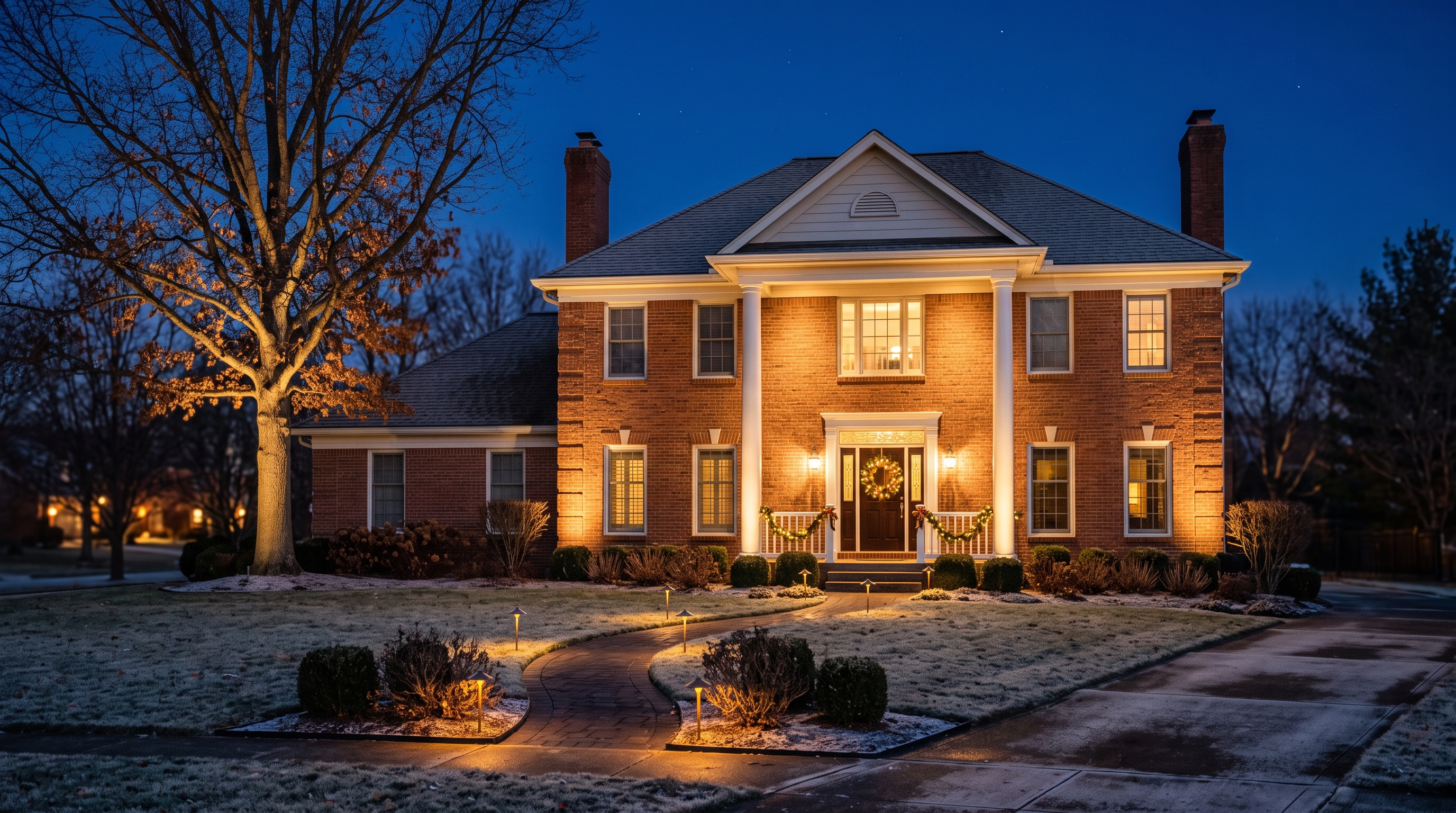
Between Thanksgiving and New Year's, our repair calls across Greater Cincinnati change. We see fewer burned-out bulbs and more cut cables, tripped outlets, and fixtures knocked out of aim. Most of it traces back to holiday decorating, and nearly all of it is avoidable if you know where your landscape lighting runs before the first inflatable goes in the yard. Thanksgiving falls on November 26 this year, so early October is a good time to plan.
Can holiday decorations damage landscape lighting?
Yes. Holiday decorations are one of the most common causes of landscape lighting damage we see in November and December, and the damage usually happens during setup.
A low-voltage landscape lighting system has three parts that decorations run into:
- Direct-burial cable. The wire that feeds your path lights and uplights is often only a few inches under the mulch or turf. A yard stake, a sign post, or the anchor stake on an inflatable can go straight through it.
- The transformer and its outlet. The transformer plugs into a 120-volt outdoor receptacle, usually on the side of the house. When holiday lights share that outlet or circuit, a trip takes the landscape lighting down with it.
- The fixtures themselves. Path lights and uplights get used as anchor points for garland, light strings, and extension cords, which pulls them out of aim or cracks the stem.
Why do yard stakes cut landscape lighting wire?
Yard stakes cut landscape lighting wire because the cable runs through the same beds and walk edges where people put decorations, and it sits shallow enough for a stake to reach.
Inflatable anchors, candy cane markers, and light-up reindeer tend to go where the lights already are: along the front walk, around the lamp post, and in the bed under the front windows. Those are the same routes we use to run cable for path lighting and facade uplighting. A metal stake driven through a low-voltage line can sever it outright or just nick the jacket. A nick can be worse. The system may keep working for weeks until water gets in, the copper corrodes, and the far end of the run goes dark in January.
Damaged direct-burial cable is one of the five failures listed on our repair page, next to corroded connections and undersized transformers. It is also one of the easiest to prevent.
How do you find where your landscape lighting wire is buried?
Follow the fixtures. Cable almost always runs fixture to fixture, from the transformer outward, in fairly straight lines along beds and walk edges.
- Walk from the transformer to the nearest fixture and note the likely path between them.
- Connect each path light to the next one along the walk. Assume the cable runs in the bed a few inches off the hardscape edge.
- For uplights on the facade or trees, assume a run from the nearest path light or straight from the transformer.
- Mark those lines with a few garden flags, or sketch them on your phone, before anyone starts staking.
If your installer left a layout drawing, use it. If the system came with the house and nobody knows how it was wired, now is a reasonable time to have it mapped. We trace the runs before any repair or add-on so we know where the cable actually goes.
Keep decoration stakes at least a foot away from any line you have marked. When in doubt, hold inflatables down with weighted bases or sandbags instead of stakes.
Can you plug Christmas lights into a landscape lighting transformer?
No. A landscape lighting transformer steps household power down to roughly 12 to 15 volts, and standard holiday light strings are built for 120 volts. They will not run from the transformer's output, and they should never be spliced into the low-voltage cable.
What most people mean is plugging holiday lights into the same outdoor outlet the transformer uses. That is where the trouble starts. Outdoor receptacles are required to be GFCI protected, and a GFCI trips when it detects current leaking to ground. Holiday strings, cheap extension cords, and cord connectors sitting in wet leaves are a common source of that leakage. On a rainy December night, one bad connector trips the outlet, and your holiday display and your landscape lighting go dark together.
A few habits keep that from becoming a service call:
- Put holiday lights on a different outdoor outlet or circuit than the transformer when you can.
- Keep plug connections off the ground. A plastic bag is not a weatherproof enclosure.
- If the landscape lights go out after a storm, check and reset the GFCI outlet before you assume the transformer failed.
Should you hang holiday lights on landscape lighting fixtures?
No. Don't hang holiday lights, garland, or cords on landscape lighting fixtures. They are not built to carry weight, and a small tug is enough to knock them out of aim.
A path light stem is designed to hold a fixture head upright in soil. Wrapping a light string around it, or tying an extension cord to it to keep the cord off the walk, puts sideways load on the stake. After a few weeks of wind and freeze-thaw, the fixture leans, the pool of light shifts off the walkway, and the stake loosens in the ground.
Uplights are even more sensitive. An uplight aimed at a column or a tree trunk only has to move a few degrees before it lights the gutter or the neighbor's window instead. Garland draped over the fixture also traps heat and moisture against the lens.
How can existing landscape lighting make holiday decor look better?
Warm white uplighting on the facade and trees already gives your decorations a lit background, so work with it instead of around it.
- Wreaths and garland on the facade. An uplight grazing the front of the house will light a wreath or door garland without an extra spotlight. Put decor where the existing light already lands.
- Trees. A lit trunk and canopy make a strong backdrop for a simple display in front of the tree. You may not need to wrap the whole thing.
- Walkways. Path lights already mark the route to the door. Luminaries or low decor along the walk look best set between path lights, not on top of them.
If a fixture got knocked out of aim over the summer or during fall cleanup, re-aim it before you decorate. Fixture re-aim is part of our annual service plans.
What should you do with your landscape lighting before you decorate?
Confirm the whole system works, mark the cable routes, and fix anything already failing. Problems are much harder to diagnose once decorations and extension cords are layered on top.
- Walk the system at dusk. Note every fixture that is dark, dim, or flickering. Dim fixtures at the far end of a run often point to voltage drop or a corroded connection.
- Mark the cable routes as described above.
- Check the transformer outlet. Make sure it has a weatherproof in-use cover and that nothing else is plugged in that doesn't need to be.
- Set your timer or photocell for early December, when Cincinnati sunset lands around 5:15 PM.
- Schedule repairs in October or early November. The ground in southwest Ohio usually stays workable for cable repair into December, but our calendar fills quickly once the first cold snap hits.
What does it cost to fix landscape lighting damaged by holiday decorations?
It depends on what broke. A single cut cable or a fixture that needs re-aiming is a small job. A system with several damaged runs, water in the connections, and a struggling transformer falls in the $750 to $4,000 range we quote for rescuing a failing system in Greater Cincinnati.
The expensive version is usually the one nobody noticed until spring. A nicked cable that sits wet all winter corrodes back from the damage point, and the repair grows from one splice to a whole section of new cable. If something goes dark in December, have it looked at then instead of waiting for the thaw.
We diagnose and repair landscape lighting of every brand, including systems we did not install, across Maineville, Mason, West Chester, Loveland, Montgomery, Indian Hill, Hyde Park, and Anderson Township. To have your system checked and the cable routes mapped before decorating season, call (513) 828-8501 or request an estimate. Diagnosis is same-week, and we will tell you plainly whether it is a bulb or a bigger problem.
Want a property like the ones in this post?
Free on-site consultation across Greater Cincinnati.
Schedule a Free Estimate