
June 20, 2026
Landscape Lighting Design in Cincinnati: How to Light Your Home the Right Way
How landscape lighting design works in Greater Cincinnati — layering, low-voltage technique, real costs, and how to avoid a runway-lit yard.
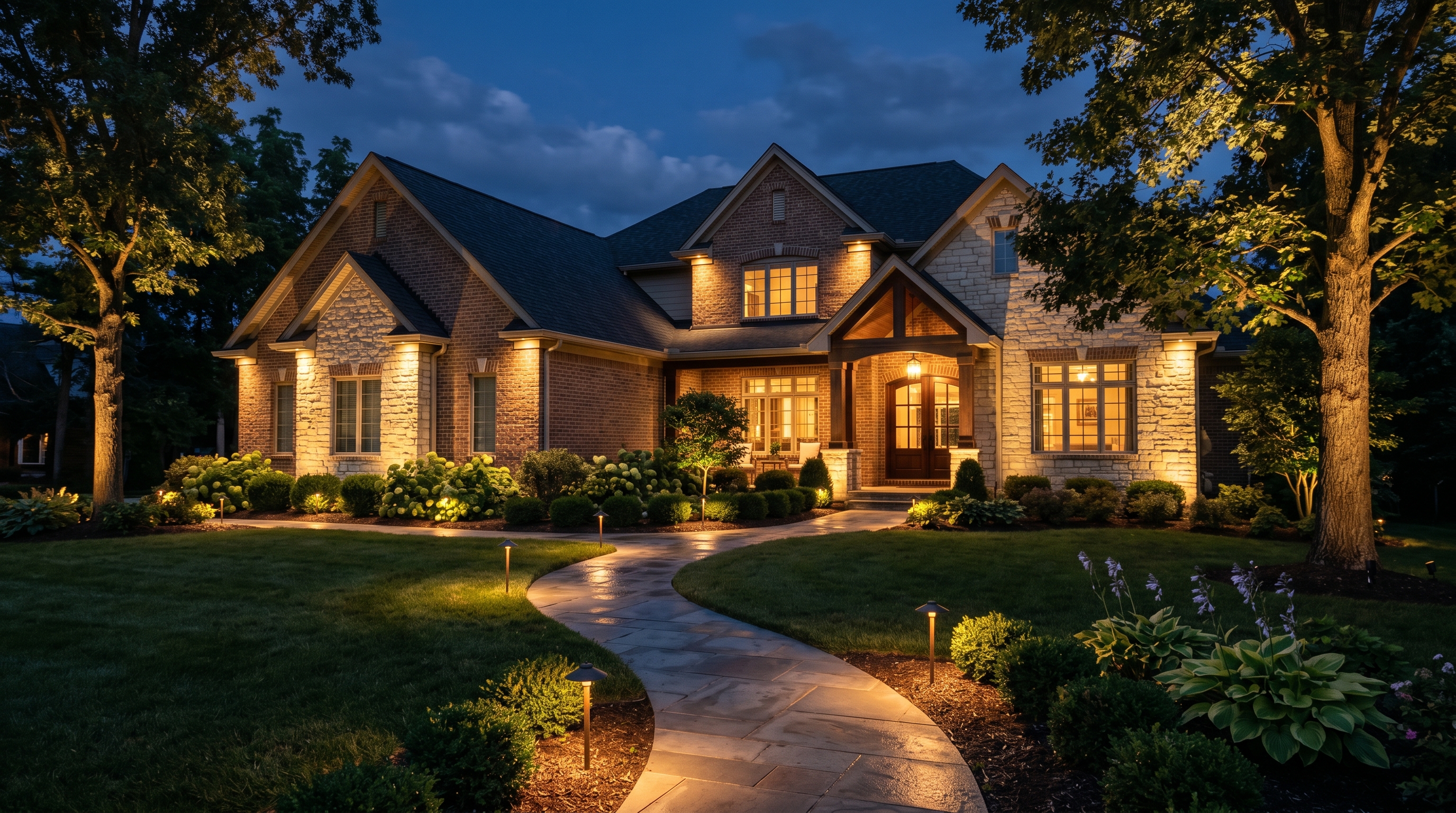
Good landscape lighting design is not about how many fixtures you can bolt to the ground. It is about layering light the way a Cincinnati home actually gets used after dark — the walk from the driveway, the view from the kitchen window, the mature oak that anchors the front yard. We design systems that look intentional at night and disappear by day, and because we also repair lighting, we design them to last and stay serviceable. Here is how landscape lighting design works in the Greater Cincinnati market, what it costs, and how to avoid the mistakes that turn a beautiful yard into a runway.
What is landscape lighting design?
Landscape lighting design is the planning process that decides where light goes, how bright it is, and what it points at — before any fixture gets installed. A real design accounts for three layers: path and safety lighting along walkways and steps, accent lighting that uplights the facade and architectural features, and feature lighting that highlights trees, water, and specimen plantings.
The goal is contrast, not coverage. The eye is drawn to the brightest spot in a dark scene, so a good design picks a few focal points — the front door, a stone column, a 40-foot oak — and lets everything else fall into supporting glow. A yard lit evenly from end to end reads flat and commercial. A yard lit with deliberate light and shadow reads like a designed space.
Design also means choosing the right technique for each target. We use uplighting (fixtures at the base aiming up) for facades and tree trunks, moonlighting (fixtures mounted high in a tree aiming down through the canopy) for a soft dappled effect across a lawn, crossfire (two fixtures hitting a tree from opposing angles) to give a trunk dimension, and low path lighting that pools light on the walkway without glaring into your eyes.
How is a landscape lighting plan actually built?
A landscape lighting plan starts with a walk of the property at dusk, not a catalog. We look at sightlines from the street, from the front door, and from the main interior windows, because most of the year you experience your lighting from inside the house looking out.
From there the design moves through a few concrete steps:
- Focal point selection. We choose three to five primary targets — usually the facade, the entry, and one or two specimen trees — and build the scene around them.
- Fixture and beam-spread choice. A wide flood beam washes a broad brick wall; a narrow spot beam climbs a tall tree trunk. Picking the wrong beam angle is the most common reason a facade looks blotchy.
- Spacing and layering. Path lights are spaced roughly every 8 to 12 feet, staggered rather than lined up like an airport, so the walkway reads as a soft ribbon of light instead of dots.
- Transformer and VA budget. Every low-voltage system runs off a transformer, and the total wattage of the fixtures (measured in VA) cannot exceed roughly 80 percent of the transformer rating. A design that ignores the VA budget either overloads the transformer or leaves you no room to expand later.
- Wire runs and voltage drop. Long cable runs lose voltage, so distant fixtures dim unless the runs are hubbed and the wire gauge is sized correctly. This is invisible on paper and obvious the first night if it was done wrong.
The result is a system where each fixture has a reason to exist. If we cannot explain what a light is pointing at, it does not go in the plan.
Why does low-voltage design matter for a Cincinnati home?
Low-voltage landscape lighting matters because it is safer, more flexible, and far easier to maintain than line-voltage systems — which is exactly why nearly every quality residential design in Greater Cincinnati runs on it. Low-voltage means a transformer steps your home current down to 12 volts before it ever reaches the yard, so the cable carries a fraction of the shock and fire risk of full household power.
For design, that low voltage is a gift. Fixtures can be moved, added, or re-aimed without an electrician, which means a system can grow as a young tree matures or as you finish a patio. It also means the design can be tuned after dark on install night — we routinely re-aim a dozen fixtures once the sun is fully down and we can see the real effect.
Cincinnati conditions push the design further. Our freeze-thaw winters heave soil and crack cheap fixtures, our clay holds water around poorly sealed connections, and our mature tree canopy on the east side means a lot of moonlighting and shade-aware aiming. A design built for this market uses brass or copper fixtures that survive the seasons, waterproof silicone-filled connectors instead of the twist-on caps that corrode in a year, and mounting that accounts for trees growing into beam paths over time.
How much does landscape lighting design and installation cost in Cincinnati?
A professionally designed and installed landscape lighting system in the Greater Cincinnati market typically runs from about 3,000 dollars for a focused front-yard design to 8,000 dollars or more for a full property with facade, trees, and rear entertaining areas. Most homeowners land somewhere in the middle.
The cost breaks down along a few honest lines:
- Fixture count and quality. A typical front-yard design uses 10 to 18 fixtures. Quality brass and copper fixtures cost more up front than cast aluminum or plastic but last 15 to 20 years instead of 3 to 5, which is the real difference between a system you install once and one you replace.
- Transformer and controls. A properly sized transformer with a photocell or smart timer is a few hundred dollars and is not the place to cut corners — it is the heart of the system.
- Trenching and wire. Longer runs, hardscape crossings, and dense plantings add labor.
- Design complexity. Moonlighting fixtures placed high in trees and multi-zone control cost more than a simple path-and-facade layout.
Be cautious with quotes that come in dramatically low. A 1,200-dollar “full yard” package almost always means plastic fixtures, undersized transformers, and twist-cap connections that fail in a season — we know because we are usually the ones called to fix them two winters later. The honest math is that a cheap install plus the repair and replacement it forces costs more than doing it right the first time.
What is the difference between professional design and a DIY kit?
The difference between a professional landscape lighting design and a big-box DIY kit is engineering and longevity — the kit lights the yard for a season, the design lights it for a decade. DIY kits use sealed plastic fixtures, thin wire, and a small transformer sized for the exact pieces in the box, with no room to expand and no voltage-drop planning.
A few specific gaps show up fast:
- Voltage drop. DIY kits daisy-chain fixtures on one run, so the lights farthest from the transformer are visibly dimmer. A designed system hubs the wiring so every fixture gets the same 12 volts.
- Fixture quality. Plastic lenses cloud and yellow within a couple of seasons; brass and copper develop a patina but keep their output.
- Aiming and glare. A kit drops light where the stake lands. A design hides the source and shows only the effect, so you never look into a bare bulb.
- Serviceability. When a DIY fixture fails, the sealed unit usually has to be thrown out. We design with serviceable fixtures and keep parts for older systems — including ones we did not install.
That last point is our line in this market. Most outdoor lighting companies in Cincinnati only sell new installs and walk away. We design systems we can come back and maintain, and we fix what others will not — which is why we design every system to be opened, re-aimed, and serviced for years, not sealed shut.
When is the best time to design landscape lighting in Cincinnati?
The best time to plan and install landscape lighting in Cincinnati is spring through early fall, when the ground is workable and you get the most use out of the system during long evenings and outdoor entertaining. April through September is peak season for a reason — the yard is mature, the soil trenches cleanly, and you enjoy the result immediately.
That said, design is a year-round conversation. Fall is an excellent time to plan and lock in a system before the holiday season, and winter installs are entirely doable in our market between freezes — the demand simply drops, which can mean faster scheduling. If you are pairing landscape lighting with a new patio, walkway, or planting project, the smart move is to plan the lighting design alongside the hardscape so wire sleeves can be run before anything is poured. Retrofitting around finished concrete is possible but always harder than planning ahead.
How do I get a landscape lighting design for my property?
Start with an on-site evening consultation. A landscape lighting design cannot be done well from a satellite photo — it needs someone standing in your yard at dusk, reading the sightlines and the architecture. We design for homes across Greater Cincinnati, including Mason, West Chester, Loveland, Montgomery, Indian Hill, Hyde Park, and Anderson Township, and we base every plan on how your specific property lives after dark.
A good design conversation covers what you want to feel when you pull in the driveway, which views matter most from inside the house, and how the system should be able to grow over time. From there we build a layered plan with a real fixture count, a sized transformer, and a VA budget you can expand against later — then we install it and stay available to maintain it. Because we both design and repair, the system we hand you is one we are prepared to stand behind for years.
Want a property like the ones in this post?
Free on-site consultation across Greater Cincinnati.
Schedule a Free Estimate