
July 21, 2026
Low-Voltage Landscape Lighting in Cincinnati: How It Works and Why It's the Right Choice
How low-voltage landscape lighting works, why it beats line-voltage for Cincinnati homes, and how to size a transformer that lasts.
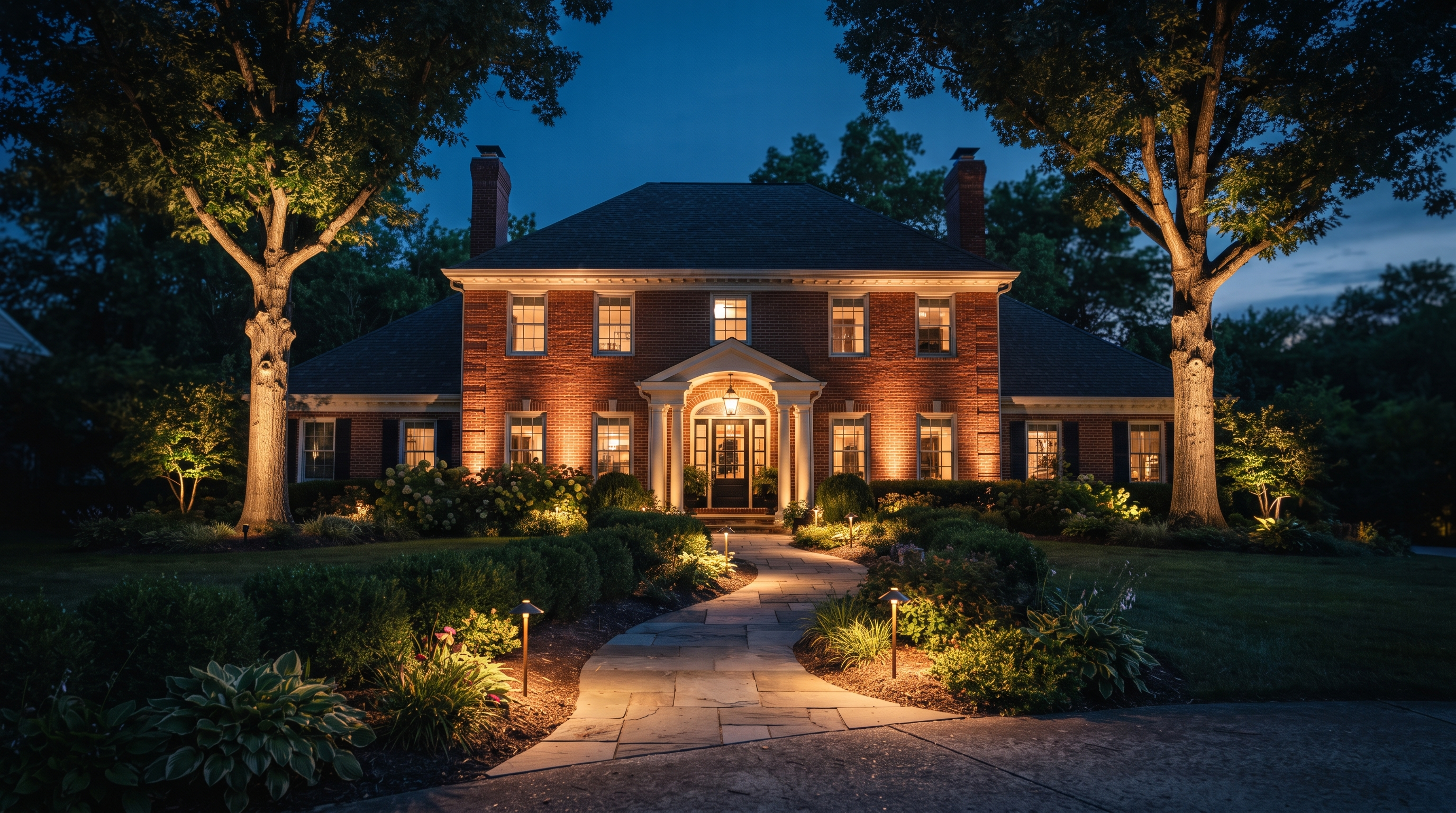
Nearly every professional landscape lighting system we install around Greater Cincinnati runs on low voltage — 12 volts, stepped down from your home’s 120-volt supply by a transformer. If you have ever wondered what that actually means, why it matters, and whether the low-voltage system in your yard is built right, this is the plain-language version from the crew that spends its weeks elbow-deep in transformer boxes from Mason to Anderson Township.
What is low-voltage landscape lighting?
Low-voltage landscape lighting is a system that converts standard 120-volt household power down to 12 volts before it reaches any fixture in your yard. A transformer — usually a stainless box mounted near the garage or on a basement wall — does the conversion. From there, direct-burial cable runs a few inches under the mulch and lawn to each path light, uplight, and tree fixture.
Because the fixtures only ever see 12 volts, the whole system downstream of the transformer is dramatically safer than line voltage. A dog chewing a wire, a shovel nicking a run, a flooded fixture after one of our spring storms — with low voltage these are repair calls, not emergencies.
How does low-voltage compare to line-voltage lighting?
For residential landscape lighting, low voltage wins on almost every count: safety, installation cost, flexibility, and efficiency. Line voltage — full 120-volt power run to each fixture — still has a place for large commercial floodlighting, but for a Cincinnati home it is usually the wrong tool.
- Safety. Line voltage in a wet landscape requires conduit, deep trenching, and an electrician for every change. Twelve volts can be buried shallow and will not hurt a child or pet who finds an exposed wire.
- Installation. Low-voltage cable slips under mulch and sod with minimal disruption. Line voltage means trenching 18 inches down through your root zones and irrigation.
- Flexibility. Want to move a path light two feet because the hostas filled in? On low voltage that is a ten-minute adjustment. On line voltage it is a permit-grade project.
- Efficiency. Modern low-voltage LED fixtures draw 4 to 8 watts each. A 20-fixture system often runs on less power than two old-style porch floodlights.
How big of a transformer do you need?
Size the transformer to about 80 percent of its rated capacity at most — that is the rule we install by. Transformers are rated in VA (volt-amps, effectively watts for this purpose). Add up the wattage of every fixture on the system, then leave headroom.
A typical example: 12 path lights at 4 watts each is 48 watts, plus 6 facade and tree uplights at 7 watts each is 42 more — 90 watts total. That system belongs on a 150 VA transformer, not a 100 VA unit running near its ceiling. The headroom keeps the transformer cool, extends its life, and leaves room to add three or four fixtures later without replacing the core of the system.
Where we see problems is the opposite direction: big-box kits with a small plug-in transformer maxed out on day one. Those systems dim at the far end of the run, eat bulbs, and fail early — and the homeowner is told the whole thing needs replacing when it usually does not.
Why do low-voltage systems fail, and can they be fixed?
Almost every failed low-voltage system we open up comes down to one of four things: corroded wire connections, a failed or undersized transformer, voltage drop on long runs, or fixtures that filled with water. All four are fixable.
The most common culprit is the cheap pierce-style connector that came with a builder-grade install. It punctures the cable insulation, moisture wicks in, and two or three seasons of Ohio freeze-thaw later, half the yard is dark. We cut those out and replace them with waterproof gel-filled or heat-shrink connections that stay sealed.
This is also where we differ from most companies in the Cincinnati market: the franchise installers largely will not touch a system they did not sell. We troubleshoot and repair low-voltage systems regardless of who installed them — we keep parts on the truck for older transformers and discontinued fixture lines, because a five-year-old system with a bad connection does not need to become a full re-install.
Is low-voltage lighting bright enough?
Yes — properly designed low-voltage LED lighting produces all the light a residential landscape needs, and the real design skill is restraint, not raw output. A quality low-voltage uplight delivers 300 to 700 lumens with precise beam control, which is plenty to wash a two-story brick facade or reach the canopy of a mature oak. Path lights need far less — 100 to 200 lumens spaced roughly 8 to 10 feet apart reads as an even, welcoming glow instead of an airport runway.
Brightness problems in low-voltage systems are almost always voltage-drop problems in disguise: too many fixtures on one long cable run, so the last lights in line receive 9 or 10 volts instead of 12. The fix is splitting the load across multiple home runs from the transformer, not buying bigger bulbs.
What should a low-voltage system cost in Cincinnati?
A professionally installed low-voltage system for a typical Greater Cincinnati front yard runs roughly $2,500 to $6,000, with larger estate properties in Indian Hill or Montgomery going well beyond that. That price should include a quality multi-tap transformer, solid brass or copper fixtures, direct-burial cable properly sized for the runs, sealed waterproof connections, and a real warranty on both parts and labor.
If a quote comes in at half that, look at the fixture spec — powder-coated aluminum fixtures and pierce connectors are how the number gets low, and they are also why so much of our repair work exists. Brass and copper cost more up front and then last decades in the ground.
What is the next step?
If you are planning a new system, or you have a low-voltage system that is dim, flickering, or half-dark, start with a walkthrough. We serve Maineville, Mason, West Chester, Loveland, Montgomery, Indian Hill, Hyde Park, and Anderson Township, and we design, install, and repair low-voltage landscape lighting every week of the year. Call Greater Cincy Outdoor Lighting at (513) 828-8501 and we will tell you honestly whether your system needs a repair, an upgrade, or nothing at all.
Want a property like the ones in this post?
Free on-site consultation across Greater Cincinnati.
Schedule a Free Estimate