
August 31, 2026
Outdoor Floodlighting in Cincinnati: How to Get Security Without the Glare
Cincinnati sunsets reach 7:15 PM by late September. Here is how to floodlight your home for security without blinding your neighbors.
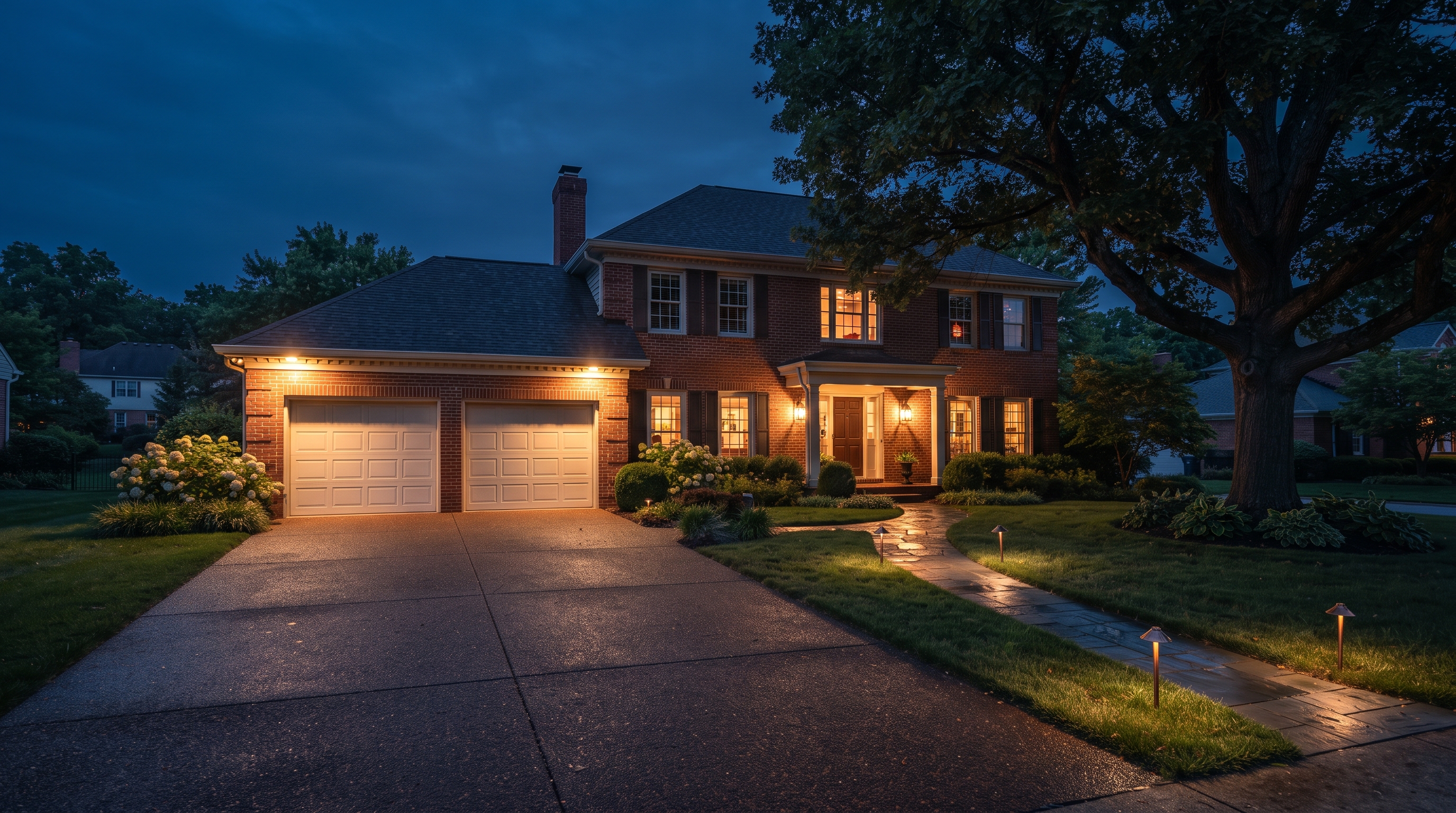
By the end of September, sunset in Cincinnati lands around 7:15 PM, and by early November it is closer to 5:30. If your driveway, side yard, or back patio goes black the moment the sun drops, this is the month homeowners start calling us about floodlighting. It is also the month we get called to fix floodlighting done badly: a 5000K wall pack aimed straight into the neighbor's kitchen window, or a motion flood so bright the homeowner's own security camera washes out.
Good floodlighting gives you visibility and security. Bad floodlighting gives you glare, dark shadows behind the glare, and a note from the HOA. Here is how we approach it across Maineville, Mason, Loveland, West Chester, and the rest of Greater Cincinnati.
What is floodlighting, and how is it different from landscape lighting?
Floodlighting is wide-beam illumination that covers a large area, usually a driveway, side yard, garage face, or backyard, from a fixture mounted high on the house, garage, or a tree. Where a path light covers a 6 to 8 foot circle and an uplight paints a single column or tree trunk, a flood fixture with a 60 to 120 degree beam can cover several hundred square feet from one mounting point.
The two systems also run differently. Most decorative landscape lighting is low-voltage (12V off a transformer). Floods can be low-voltage too, and for most homes that is what we install: a 12V flood pulling 6 to 12 watts of LED puts out 500 to 900 lumens, which is plenty when it is mounted 10 to 15 feet up and aimed correctly. Line-voltage floods in the 2000+ lumen range have a place on large rural lots and long driveways, but on a half-acre suburban lot in Mason they are usually overkill.
How much light do you actually need for security?
Less than most people think. For a residential driveway or yard, 0.5 to 2 footcandles at ground level is enough to identify a person, read a face on camera, and walk without tripping. A typical big-box 3000 lumen twin-head flood at 15 feet delivers several times that directly under the fixture, then falls off to near-zero at the edges. The result is a bright hot spot surrounded by shadows that look darker by contrast, because your eyes adapt to the brightest thing in view.
Two or three moderate floods spaced apart beat one blinding fixture every time. Even coverage at a lower level lets your eyes (and your cameras) see the whole scene. That is the core principle, and it is the one cheap installs get wrong most often.
How do you stop floodlights from creating glare?
Three things control glare: aiming angle, shielding, and color temperature.
- Aim down, not out. A flood aimed within about 45 degrees of straight down lights the ground. Aimed near horizontal, it lights your neighbor's windows and every driver on the street. If you can see the bare LED chip from the sidewalk, the fixture is aimed wrong.
- Use shielded or hooded fixtures. A glare shield or hood keeps the source itself out of sight lines so you see lit ground, not a bright dot. Full cut-off fixtures also keep light out of the night sky, which matters in neighborhoods like Indian Hill and Loveland where residents care about dark backyards.
- Stay warm. We install floods at 2700K to 3000K, the same warm white as the rest of a landscape lighting system. The blue-white 5000K floods sold as security lights scatter more in your eye, feel harsher, and make a brick colonial look like a car dealership. Warm LED at the same lumen output reads as calmer and still shows true color on camera.
Should security floodlights be motion-activated or always on (dusk to dawn)?
For most Cincinnati homes the right answer is both, split by zone. Run a low, steady dusk-to-dawn layer over the areas you use and see every night: the driveway apron, the walk from the garage, the patio. Then put motion-activated floods on the low-traffic sides of the house, the side yard and the back fence line, where a light snapping on actually means something.
A motion flood over the driveway you pull into every night just trains everyone to ignore it. A motion flood on a dark side yard that stays off 99 percent of the time is a genuine alert. Photocells and astronomic timers handle the dusk-to-dawn layer automatically through the season, so the system tracks Cincinnati's shrinking daylight without you touching a switch. We covered timer and photocell settings in detail in our fall timer guide if you want the specifics.
Where should floodlights go on a typical Greater Cincinnati home?
Walk the property at night before mounting anything. The spots that matter on most of the homes we service:
- Garage peak or eave, aimed at the driveway. The workhorse location. One shielded flood 12 to 15 feet up covers a two-car driveway.
- Side yards. Usually the darkest zone on the lot and the most common approach path nobody watches. One motion flood per side is typically enough.
- Back corners of the house, crossed. Two fixtures aimed diagonally across the backyard cover it more evenly than one big flood in the middle, and each fills the other's shadows.
- Detached structures. Sheds and pole barns in Maineville and Loveland backyards are frequent break-in targets and almost never lit.
One more option worth knowing: mounting a flood 20 or more feet up in a mature tree and aiming it down through the branches. The trade calls it moonlighting, and it produces soft, dappled coverage over a patio or lawn that does not look like security lighting at all. It covers the same ground a harsh wall-mounted flood would, without the fortress effect.
What does floodlighting cost in Cincinnati, and can it be added to an existing system?
As part of a low-voltage system, expect roughly $150 to $400 per flood fixture installed, depending on fixture grade (cast brass costs more than aluminum and outlasts it) and wire runs. Adding three or four floods to an existing landscape lighting system typically runs $600 to $1,500, provided your transformer has the capacity. That is the first thing we check: a 300VA transformer already loaded to 250VA has no room for four more 10-watt heads, and an overloaded transformer is one of the most common failures we repair.
And yes, we add floods to systems we did not install. Most franchise outfits around Cincinnati will only quote you a full new system; we will open up a five-year-old transformer box someone else wired, sort it out, and extend it. If your current floodlights are the problem, glaring, half-dead, or snapping on at 2 PM, we fix those too.
If you want the driveway lit before the 5:30 sunsets get here, call us at (513) 828-8501 or request a free design consultation. We serve Maineville, Mason, West Chester, Loveland, Montgomery, Indian Hill, Hyde Park, and Anderson Township.
Want a property like the ones in this post?
Free on-site consultation across Greater Cincinnati.
Schedule a Free Estimate