
June 29, 2026
Outdoor Security Lighting in Cincinnati: How to Light Your Property Without the Harsh Glare
Security lighting done right deters intruders and looks good doing it. Here is how we light Cincinnati homes for safety without the floodlight glare.
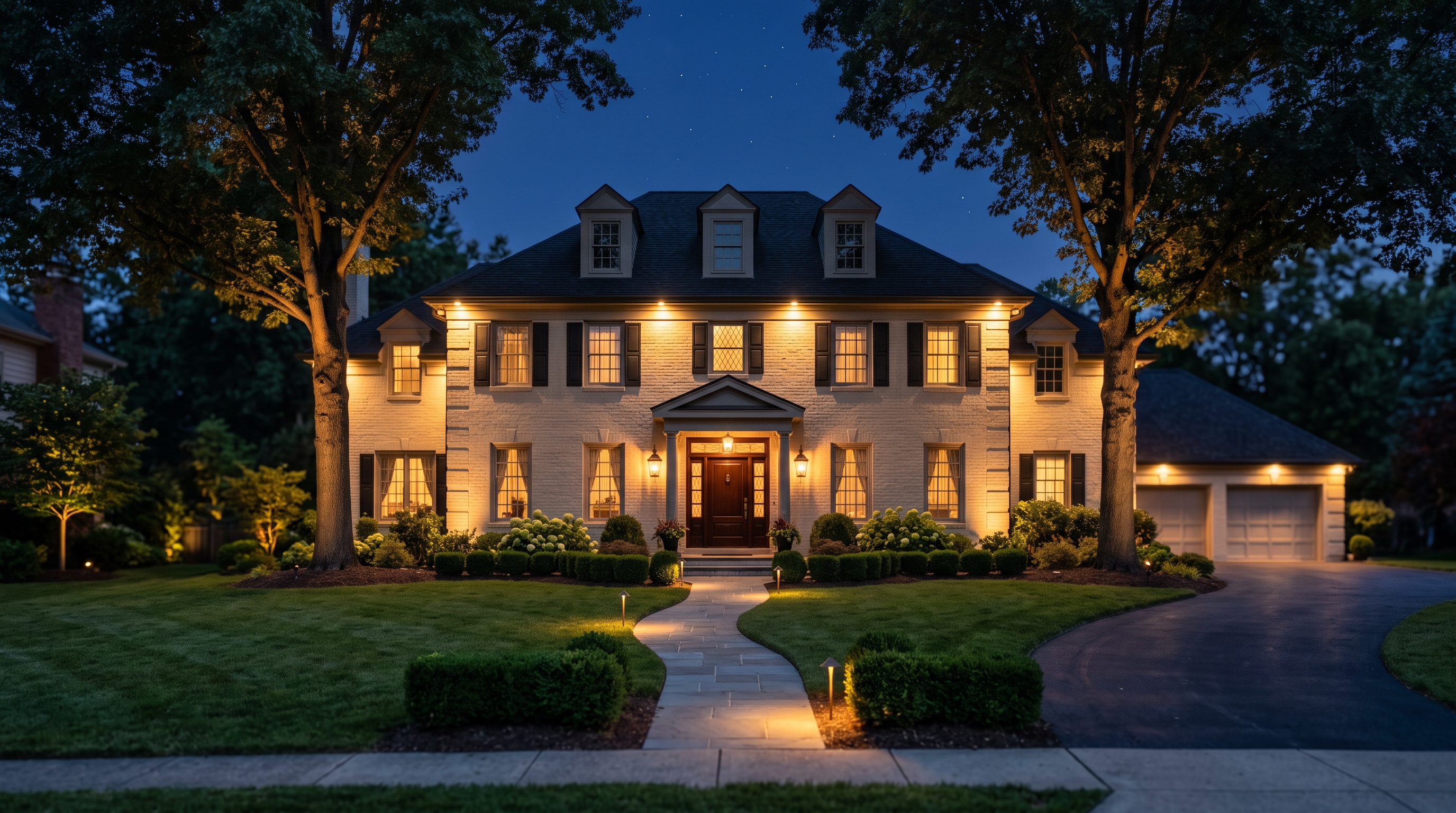
Most security lighting in Greater Cincinnati is doing half its job. A motion floodlight bolted over the garage scares off a possum at 2 AM and blinds you when you carry groceries in, but it leaves the rest of the property in deep shadow and does nothing for curb appeal. There is a better way to do this, and it is the same low-voltage approach we use for landscape lighting, tuned for safety. Below is how real security lighting works, why the cheap floodlight rarely delivers, and what we install on Cincinnati homes that actually want both protection and a property that looks good after dark.
What is the difference between security lighting and a motion floodlight?
Security lighting is a layered, always-on or dusk-to-dawn system that removes dark hiding spots across the whole property, while a motion floodlight is a single bright burst aimed at one spot. The floodlight has its place, but on its own it creates exactly the condition burglars want: sharp contrast. A 2,000-lumen flood blasting the driveway makes everything outside that cone look pitch black to the human eye, so the side yard, the back patio, and the basement window well are darker than if you had no light at all. Your eyes adjust to the bright spot and lose the shadows.
Good security lighting works the opposite way. We use a layer of lower-output fixtures — glare-controlled floods, downlighting tucked under the eaves, path lights along walkways, and uplighting on the corners of the house — so the entire property carries a soft, even wash of light with no deep pockets of shadow. Nothing is blinding, but there is nowhere to hide. That is the principle that lighting designers and police crime-prevention units both point to: even illumination beats high contrast every time.
Why do cheap security floodlights fail so fast in Cincinnati?
The big-box motion floodlight fails because it is line-voltage hardware bolted to an exterior wall and left to fight Ohio weather alone. We pull a lot of dead ones off Cincinnati homes, and the pattern is always the same. The motion sensor is the first to go — the photocell and PIR sensor sit in a sealed plastic head that bakes in summer sun and freezes in January, and after two or three seasons it either stops triggering or triggers at every passing car. Then water finds the wall penetration. Line-voltage (120-volt) fixtures mounted to siding rely on a caulk seal that cracks, and once moisture reaches the connection you get corrosion, nuisance tripping, and eventually a dead circuit.
Low-voltage security lighting avoids most of that. It runs on 12 volts off a transformer, the connections are made with proper waterproof silicone-filled wire nuts at the fixture, and the fixtures are cast brass or copper rather than stamped plastic. A brass fixture that costs more up front outlives three of the plastic floods, and because it is 12-volt there is no shock hazard if a homeowner or a pet gets near a damaged wire. This is also why we get so many repair calls that start with “the security light over the garage died again” — the answer is usually to stop replacing the same disposable fixture and build a real layer instead.
Where should security lights actually go on a Cincinnati property?
The fixtures should follow the property line, the entry points, and the dark corners — not just the front door. When we walk a Cincinnati home for security lighting, we are looking for the spots a person could approach unseen, and on most properties here those are predictable. Here is where we focus:
- Entry doors and the garage approach. Soft downlighting from above the door, not a flood in your face. You want to see who is at the door and they want to know they are lit — that alone turns most people around.
- Side yards and the gap between houses. On the close lots in Hyde Park, Montgomery, and older Mason neighborhoods, the side yard is the classic blind spot. A couple of path lights or a downlight off the eave closes it.
- Basement windows and walk-out wells. A small uplight or well light here removes a favorite hiding and entry spot that no front-yard floodlight ever reaches.
- The back of the house and patio. If you light the front for security and leave the back dark, you have just told everyone which side to use. Even, low-level light across the rear matters as much as the front.
- Tree lines and fence corners. A wash of uplight on a mature tree at the property edge doubles as security and looks intentional rather than industrial.
The goal across all of these is the same: no dark gaps, no blinding contrast, and fixtures placed so the light lands on the ground and the facade rather than into a neighbor’s window or your own eyes.
Will security lighting bother my neighbors or wash out the night sky?
It will not if the fixtures are aimed and shielded properly, which is exactly what a glare-controlled low-voltage system is built to do. The complaint people have about security lighting — that one harsh flood lighting up the whole cul-de-sac — comes from cheap, un-shielded, over-bright fixtures pointed sideways. We avoid that with a few deliberate choices. We use fixtures with internal glare guards and hex louvers so the light source itself is hidden and you see the illuminated surface, not the bulb. We point downlights and floods downward at the ground or the wall, never out toward the street. And we keep the color temperature warm, around 2700K, which reads as soft amber rather than the cold blue-white that makes a yard look like a parking lot.
This is also better for actually seeing. Warm, even, shielded light gives your eyes a usable picture of the whole yard. Cold, bright, glaring light gives you a hot spot and a wall of black around it. Cincinnati does not have formal dark-sky ordinances in most townships, but good neighbors and good security point to the same setup anyway.
How much does professional outdoor security lighting cost in Cincinnati?
A real layered security lighting system on a typical Greater Cincinnati home runs in the same range as a landscape lighting install — most projects land between roughly $3,500 and $8,000 depending on the size of the property and how many zones we are covering. A focused package that lights the entries, the garage approach, and the two main dark corners sits at the lower end. A full perimeter system on a larger Indian Hill or West Chester lot, with the back of the house, the side yards, the tree line, and the walkways all covered, sits at the upper end. That includes the transformer, the brass fixtures, the buried direct-burial wire, and the labor to do the connections right.
Compare that to buying four motion floodlights at the hardware store for a couple hundred dollars — cheaper today, but you are replacing them every few years, you have an unlit property between the hot spots, and you have line-voltage wiring on your exterior walls. We are honest about this with every homeowner: if you only want one light over the garage, a quality fixture and an outlet is fine and you do not need us. If you want the property genuinely covered and looking good doing it, that is a system, and a system is what holds up.
The bottom line for Cincinnati homeowners
Security lighting and good-looking landscape lighting are the same craft pointed at a different goal. The right approach is a layered low-voltage system that washes the whole property in soft, even, shielded light — no dark hiding spots, no blinding glare, and fixtures built to survive Ohio winters. We design it that way from the start, and because we maintain what we install, we are the ones who keep it working in year five when the cheap floods would have failed twice over. If your current setup is one harsh flood and a lot of shadow, or a dead security light you keep replacing, that is exactly the kind of work we do. Call us at (513) 828-8501 and we will walk your property after dark to show you where the gaps are.
Want a property like the ones in this post?
Free on-site consultation across Greater Cincinnati.
Schedule a Free Estimate