
July 13, 2026
Path Lighting in Cincinnati: Fixture Spacing, Costs, and Getting It Right
How to space path lights, size a transformer, and price a walkway lighting system in Greater Cincinnati the right way.
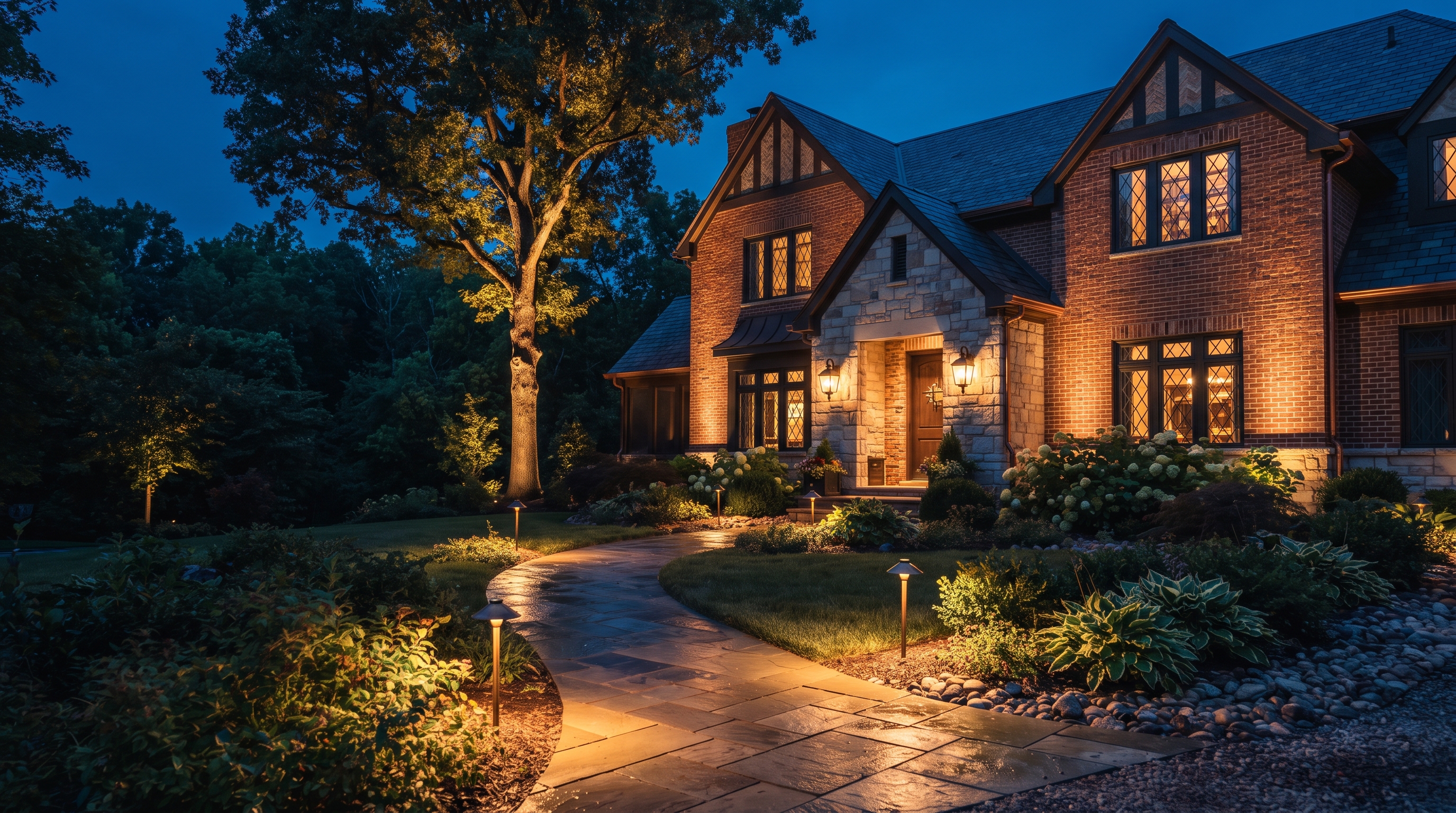
Good path lighting in Cincinnati comes down to two things most homeowners never hear from the companies quoting them: correct fixture spacing and a transformer sized with room to spare. Get those right and a walkway reads as one calm, even ribbon of light. Get them wrong and you end up with the runway look — bright hot spots with dark gaps between them. Here is how we plan, space, and price a path lighting job on the Ohio side of Greater Cincinnati.
What is low-voltage path lighting, and why is it the standard here?
Path lighting is a run of short fixtures — usually 18 to 24 inches tall — set along a walkway or driveway to light the ground you walk on. Nearly every quality install in the Cincinnati area is low-voltage, meaning a transformer steps your 120-volt house power down to 12 volts before it ever reaches the yard. That is the same 12 volts as a car battery, which is why the buried cable is safe to work around and why we can add or move a fixture years later without an electrician.
The fixtures themselves matter. We install solid brass and copper path lights because they hold up to Ohio winters, road salt, and mowers — cast aluminum and plastic units are what you find failing on the five-year-old systems we get called to repair. A brass fixture develops a living patina and keeps working; a cheap one corrodes at the socket and goes dark.
How far apart should path lights be spaced?
For most residential walkways we space path lights 8 to 12 feet apart, staggered rather than lined up like soldiers. The exact gap depends on the fixture’s beam spread and mounting height, but the goal is always the same: the pools of light should just touch or gently overlap so there is no dark zone between them. That is the difference between a walkway that feels lit and one that feels dotted.
A few things we adjust in the field:
- Curves and steps get tighter spacing. Anywhere the footing changes — a step, a turn, the edge of a driveway apron — we add a fixture so the eye has a light exactly where the foot needs guidance.
- Fewer, better-placed lights beat a crowd. A 40-foot front walk usually needs four to six fixtures, not ten. Over-lighting a path is a real mistake; it flattens the yard and wastes VA budget you could spend uplighting the house.
- We keep them off the pavement edge. Setting fixtures 6 to 12 inches back into the bed protects them from snow shovels and mower wheels and keeps the light aimed down where it belongs.
How big a transformer does a path lighting system need?
The transformer has to supply enough wattage — measured in VA — to run every fixture with headroom left over, and this is where most bargain installs go wrong. We total the wattage of all the fixtures and then size the transformer so that load lands around 60 to 80 percent of its rated VA, never maxed out. A system pulling 240 watts belongs on a 300-watt transformer, not a 300-watt transformer already stuffed to the top.
Why the headroom? Two reasons. First, LED fixtures draw very little — a modern LED path light runs 3 to 7 watts versus 20-plus for the old halogen units — so a properly sized transformer leaves you room to add uplights or tree lighting later without a second transformer. Second, voltage drops over a long cable run, and a transformer with multiple voltage taps lets us compensate so the fixture at the far end of the run is as bright as the first one. A transformer running at its ceiling has nothing left to give, and that is the system that starts flickering in year three.
What does path lighting cost in the Cincinnati area?
A professionally installed path lighting project in Greater Cincinnati typically runs a few hundred dollars per fixture installed, all in — brass fixture, LED lamp, buried cable, connections, and the share of the transformer and labor. A small front-walk system of four to six lights is a smaller job; a full walkway-plus-driveway run with a properly sized transformer is more. We quote the real range up front rather than a teaser number, because the cheap-quote game — plastic fixtures, an undersized transformer, cable stapled instead of buried — is exactly what fails and lands on our repair schedule two winters later.
If your existing path lights have gone dark or dim, you may not need a whole new system. This is our differentiator: most companies here only sell new installs and won’t touch a system they didn’t put in. We keep parts for older low-voltage systems and will troubleshoot a failing transformer, a corroded connector, or a nicked cable rather than tell you to start over.
Ready to light your walkway the right way?
We design and install path lighting across Maineville, Mason, West Chester, Loveland, Montgomery, Indian Hill, Hyde Park, and Anderson Township — and we maintain what we install. If you want an even, warm, correctly spaced walkway that still works in five years, call us at (513) 828-8501 or request a design consultation. We will walk the site at dusk, count the fixtures it actually needs, and give you an honest number.
Want a property like the ones in this post?
Free on-site consultation across Greater Cincinnati.
Schedule a Free Estimate