
July 7, 2026
Tree Lighting in Cincinnati: How to Uplight and Moonlight Your Mature Trees
Mature trees are the best thing you can light in a Greater Cincinnati yard. Here is how uplighting, moonlighting, and crossfire actually work, how many fixtures a big oak takes, and what it costs.
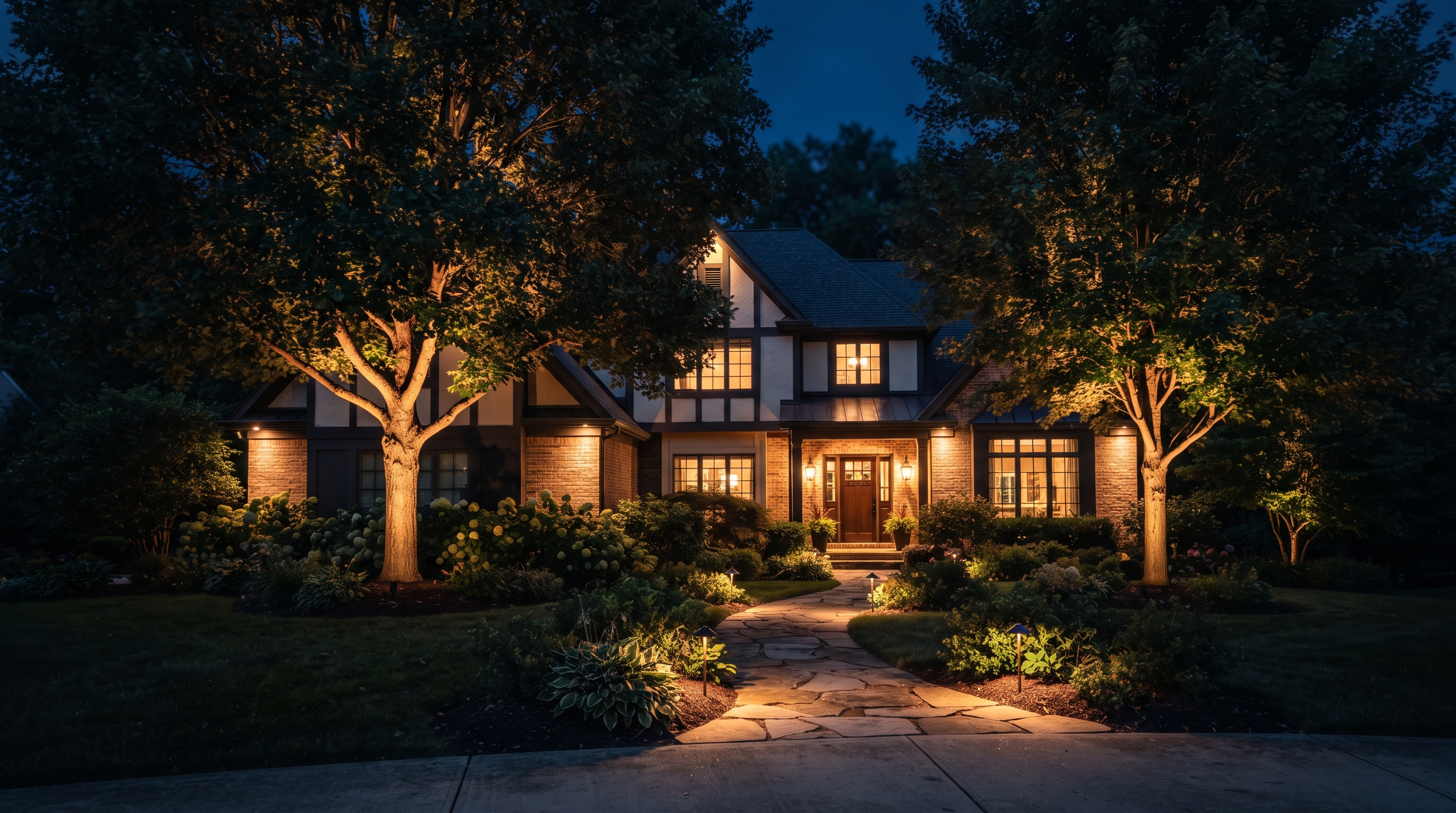
A well-lit tree does more for a yard at night than any other single fixture. In Greater Cincinnati, where a lot of homes sit under mature oaks, maples, and river birches, tree lighting is where landscape lighting stops looking like a builder package and starts looking custom. This is one of our favorite parts of the job, and it is also where the difference between a crew that understands trees and one that just points a light up shows the most.
Below we walk through how tree lighting works, the three techniques we use, which trees are worth lighting, how many fixtures a mature tree actually takes, and what it costs in the Cincinnati market.
What is tree lighting and how does it work?
Tree lighting is the practice of placing low-voltage LED fixtures in and around a tree to light the trunk, branches, and canopy after dark. Everything we install runs on a 12-volt system fed by a transformer, so the fixtures are safe to bury near roots and safe to handle. The three variables we control on every tree are beam angle (how wide the light spreads), lumen output (how bright it is), and placement (ground-mounted versus mounted up in the canopy).
A young ornamental like a Japanese maple might take a single narrow-beam uplight. A 60-foot oak in Indian Hill can take six to ten fixtures spread across trunk uplights and canopy-mounted downlights. The tree size and shape drive the whole design, which is why we never quote tree lighting off a photo alone.
What is the difference between uplighting, moonlighting, and crossfire?
These are the three core tree-lighting techniques, and most good designs combine them on the same property.
- Uplighting places fixtures at the base of the trunk aimed upward. Wide-beam fixtures wash the full canopy for drama; narrow-beam fixtures graze the trunk to show off bark texture on a shagbark hickory or sycamore. This is the workhorse technique and the most affordable.
- Moonlighting mounts small fixtures 20 to 30 feet up in the canopy, aimed down. The light filters through the leaves and casts soft, dappled shadows on the lawn and patio below, exactly the way a full moon does. It is the most natural-looking effect we do, and the one clients ask for by name once they have seen it. It takes a climb and careful cable management, which is why a lot of companies skip it.
- Crossfire (also called cross-lighting) uses two or more fixtures on opposite sides of the trunk aimed at each other. It eliminates the flat, one-sided look you get from a single uplight and gives a full tree real depth and dimension.
On a signature front-yard tree we will often uplight the trunk, crossfire the lower canopy, and moonlight from above so the whole thing reads as three dimensional instead of a flat green blob.
Which trees in a Greater Cincinnati yard are worth lighting?
The best candidates are mature specimen trees with interesting structure, and most Greater Cincinnati properties have at least one. We prioritize:
- Large shade trees (oak, maple, sycamore) with a broad canopy and a strong trunk line, these carry the whole nighttime scene
- Textured-bark trees (shagbark hickory, river birch, London plane) that reward a tight grazing beam
- Ornamentals near the entry (Japanese maple, dogwood, crape myrtle) that frame a front door or walkway
- Evergreens (spruce, arborvitae) for a year-round anchor, since they hold their effect through a Cincinnati winter when the deciduous trees are bare
A single dense, low ornamental in the middle of a lawn is usually not worth the fixture count, the light has nowhere to travel. We will tell you that up front rather than sell you fixtures that will not earn their keep.
How many fixtures does it take to light a mature tree?
Plan on one to two fixtures for a small ornamental, three to four for a mid-size tree, and five to ten for a large mature shade tree. The exact count depends on canopy diameter and how many sides of the tree are visible from the house and street. A rough field rule we use:
- One trunk uplight per major visible face of the tree
- Add a second, offset uplight for crossfire on anything over about 25 feet
- Add one or two canopy downlights for moonlighting on a tree tall enough to climb safely
Fixture wattage matters as much as count. We size trunk uplights in the 4 to 7 watt LED range (roughly 300 to 550 lumens) for most trees, and step up to wider or brighter fixtures only on the biggest oaks. Every fixture draws against the transformer’s VA budget, so a tree-heavy design is one of the main reasons we spec a larger transformer, usually a 300 VA unit with room to grow, rather than the undersized box a cheaper quote hides.
How much does tree lighting cost in Cincinnati?
Individual tree lighting in the Greater Cincinnati market generally runs about 150 to 300 dollars per fixture installed, which includes the fixture, the low-voltage wire, the connection, and the labor to place and aim it. That means a single ornamental might add 300 to 500 dollars to a project, while lighting a large front-yard oak with a full uplight, crossfire, and moonlighting treatment can run 1,200 to 2,500 dollars on its own.
Moonlighting costs more per fixture than ground uplighting because it requires a safe climb, in-canopy mounting, and cable runs that stay invisible in daylight. It is worth it, but you should expect to pay for the added labor. As with the rest of our work, we quote real numbers and use commercial-grade brass and copper fixtures rated for 15-plus years, not the plastic units that fail in a couple of Ohio winters. If you have seen a suspiciously cheap tree-lighting quote, that gap is almost always in the fixture and the transformer.
Why is summer the right time to plan tree lighting?
Summer is the ideal time to design tree lighting because the canopy is in full leaf, which is exactly the condition the lighting has to work in. When we aim fixtures in July, we are seeing the real density of the foliage, the real shadow patterns moonlighting will throw, and the real coverage each uplight gets. A design aimed in bare-branch March looks completely different once the leaves come in.
Planning now also means your trees are lit for the back half of Cincinnati’s outdoor season, the long August and September evenings on the patio, before the leaves drop. And because we install and maintain what we build, we can come back through the year to re-aim fixtures as the tree grows, something the install-and-vanish companies will not do.
Ready to light your trees?
If you have a mature oak, maple, or specimen tree that goes dark every night, it is probably the highest-impact thing you can light on your property. We design tree lighting across Maineville, Mason, West Chester, Loveland, Montgomery, Indian Hill, Hyde Park, and Anderson Township, and we maintain every system we install, including the ones up in the canopy. Call us at (513) 828-8501 and we will walk the yard with you after dark to show you what your trees can do.
Want a property like the ones in this post?
Free on-site consultation across Greater Cincinnati.
Schedule a Free Estimate