
October 28, 2026
Driveway Lighting in Cincinnati: How to Light the Way for Thanksgiving Guests Arriving After Dark
Thanksgiving sunset in Cincinnati is about 5:18 PM. Where driveway lights go, how to place them around snow and tires, and what to install before the freeze.
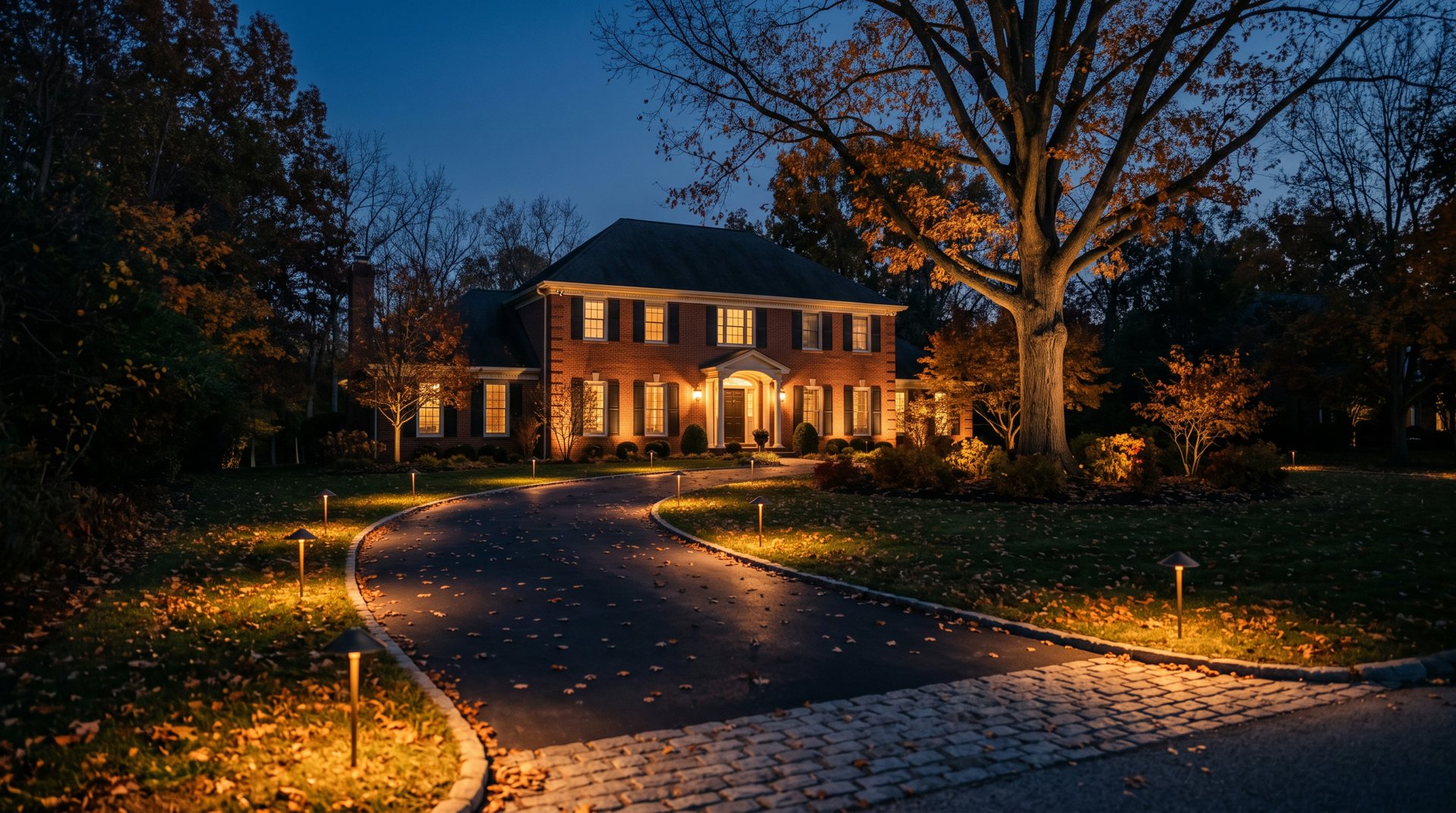
Daylight saving time ends on Sunday, November 1, and the evening loses an hour overnight. Sunset in Cincinnati moves from about 6:39 PM on Halloween to about 5:38 PM the next day. By Thanksgiving, Thursday, November 26, the sun sets around 5:18 PM, so most dinner guests pull into your driveway in full dark. If the driveway is long, curved, or sloped, or runs beside a ditch or a stone border, that first arrival is where driveway lighting earns its keep.
This guide covers what driveway lighting is, where the fixtures go, how we place them so they survive tires and snow shovels, and what to get done before the ground freezes. We install it across Maineville, Mason, West Chester, Loveland, Montgomery, Indian Hill, Hyde Park, and Anderson Township.
What is driveway lighting?
Driveway lighting is a run of low-voltage path lights along the edges of a driveway that shows a driver where the pavement ends and the lawn begins. It uses the same fixtures we put on front walkways, laid out for someone looking through a windshield instead of someone on foot.
Done well, a lit driveway reads as two soft lines of light leading up to the house. Done badly, it is a row of bright dots that makes the driver squint and hides the very edge it was supposed to show.
Why does driveway lighting matter more in November than in summer?
In November the dark arrives before your guests do. A summer cookout starts and ends in daylight. A late-November arrival at 5:00 PM is already in twilight, and civil twilight in Cincinnati ends roughly half an hour after sunset. With a 6:00 PM dinner, every car comes up the driveway in the dark and leaves in it too.
The season adds its own problems. Relatives who visit once a year do not know where the curve is or how close the drainage ditch sits to the pavement. Wet leaves cover the edge of the asphalt, and on a cold night a frosty lawn looks a lot like a frosty driveway in the headlights. Holiday gatherings also mean extra cars, so people back out, turn around on the grass, and walk between parked cars. A lit edge keeps tires off the lawn and gives people on foot a path they can see.
Where should driveway lights go?
Driveway lights go where the driver needs to see something: the entrance, every change in direction, and the spot where people leave the car and head for the front door. A straight, flat stretch needs fewer fixtures than most homeowners expect.
- The apron at the street. A pair of fixtures where the driveway meets the road tells a first-time visitor which entrance is yours. Your house number and mailbox should be readable from the car at that same spot.
- Curves and bends. We put fixtures on the outside of each curve, because that is the edge a car drifts toward.
- Hazards. A drainage ditch, a retaining wall, a Belgian block border, or a drop-off gets a light even on a straight run.
- The parking pad and turnaround. Cars back up here and people get out here, so it needs enough light to see the ground and the step up to the walk.
- The hand-off to the front walk. The driveway run should flow into the path lighting on the front walk so guests follow one line of light from the car to the door.
On a long straight run we often stagger fixtures from side to side instead of mirroring them on both edges. Staggering marks both edges with fewer fixtures and avoids the airport runway look of two perfectly matched rows.
How do you keep driveway lights from getting hit by cars and snow shovels?
We set driveway fixtures back into the turf or the planting bed, a short distance off the pavement. A path light sitting right on the asphalt line is in the way of a tire cutting the corner, a snowblower, and a shovel pushing snow onto the lawn. Pulled back a little, the fixture still lights the edge and stays out of harm's way.
Before we place anything, we ask where you or your plow service pile snow each winter, and those spots get no fixtures. The low-voltage cable runs in the lawn or bed beside the driveway. If it has to cross the pavement, it goes through a sleeve, so a future driveway repair does not cut the system. We use brass and copper fixture bodies, which take the occasional bump from a boot or shovel far better than plastic and hold up through Ohio winters for decades.
Does driveway lighting create glare for drivers?
Driveway lighting creates glare when the fixtures are unshielded, too bright, or aimed toward the car. A driver's eyes are adjusted to headlights and dark pavement, so a bare, bright lamp at windshield height is the worst thing you can put beside a driveway.
We use shielded path fixtures with warm 2700K LED lamps on a dimmable system. The light lands in soft pools on the pavement edge and the grass beside it, and from the driver's seat you notice the lit ground more than the fixtures. The same shielding keeps light out of a neighbor's front window, which matters on the tighter lots in Hyde Park and Mason as much as on the long drives in Indian Hill.
What else should you light along the driveway?
A driveway looks finished when the path lights are paired with one or two layers above them. The path lights keep cars on the pavement, and the layers above give guests something to see as they pull in.
A mature oak or maple beside the driveway can be uplit from the base or moonlit from the canopy, and in November, with the leaves down, the bare branches throw strong shadows on the lawn. Our tree lighting page covers both methods. A few uplights on the front of the house give arriving guests a lit target at the end of the drive. A single well-aimed light on an entry pillar or address stone makes the house easy to find from the street.
What does driveway lighting cost in Greater Cincinnati?
Driveway lighting is priced per installed fixture, plus the transformer and cable, so the cost follows the length and shape of the drive. A short, straight driveway may only need fixtures at the apron and the parking pad. A long, curving drive with a turnaround and a hazard edge needs more fixtures and longer cable runs, which can call for a larger transformer.
Our 2026 outdoor lighting cost guide lists the per-fixture and whole-property ranges we see in the Cincinnati market. If you already have path lighting on the front walk, a driveway run can often tie into the same transformer, which keeps the cost down. We check that capacity on the estimate visit.
Can driveway lighting be installed before Thanksgiving?
Yes, if you schedule in the next few weeks. Low-voltage cable goes into a shallow slit in the soil, and that work goes quickly while the ground is soft. Once the top few inches of soil freeze hard, which in Southwest Ohio usually happens later in December or in January, new trenching across turf has to wait for a thaw.
Early November is also a good time to design driveway lighting. The trees are close to bare, so we see the property the way it will look all winter. We set fixtures out temporarily at dusk, walk the drive with you, and adjust the spacing before anything goes in the ground.
Once the system is in, put it on an astronomical timer or a photocell so it follows the earlier sunsets on its own and you never reset it after a time change. Our post on outdoor lighting timers and photocells explains the options.
What should you do before calling for a driveway lighting estimate?
Pull into your own driveway after dark this week, around the time your guests will arrive, and write down what you cannot see. That list is most of the design brief.
- Where the edge of the pavement disappears in your headlights.
- Any ditch, wall, curb, or drop-off close to the pavement.
- Where cars park and turn around when you have company.
- Where the snow gets piled in winter.
- Whether your house number can be read from the street at night.
To get the driveway lit before Thanksgiving guests arrive, call (513) 828-8501 or request a free estimate. We will meet you at the property at dusk, walk the drive from the street to the front door, and show you where each fixture would go.
Want a property like the ones in this post?
Free on-site consultation across Greater Cincinnati.
Schedule a Free Estimate